Frontend vs backend: what's the difference?
Frontend vs backend explained: what each part of a web app does, where it runs, what it is made of, and how they work together in a real booking app.
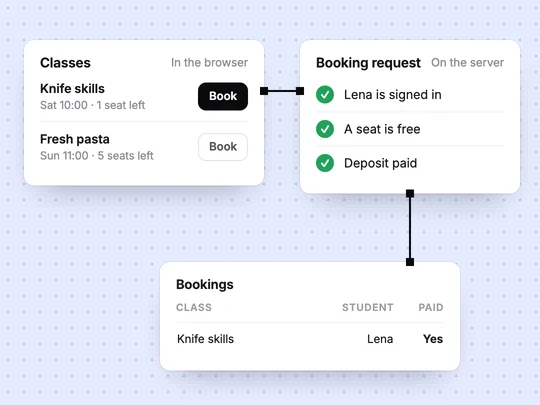
The frontend is the part of an app that people see and use: the pages, buttons and forms in their browser. The backend is the part that runs on a server behind it: it stores data, checks who is signed in, takes payments and enforces the rules. A booking site needs both, the calendar on screen and the system that makes sure two people cannot book the same seat.
What is the difference between frontend and backend?
| Frontend | Backend | |
|---|---|---|
| Where it runs | In the visitor's browser | On a server |
| What it does | Shows information and takes input | Stores data, checks permissions, runs the rules |
| Made of | HTML, CSS and JavaScript | Server code, a database, connections to other services |
| In a booking app | The class list, the calendar, the Book button | Saving the booking, checking seats, starting the payment |
| If it is missing | Nothing to see or click | Nothing is saved; every visitor starts from zero |
What does the frontend do?
It turns data into something a person can read and act on, on whatever screen they use. Good frontend work is about clarity: the most important action is obvious, forms say what went wrong, and the page works on a phone as well as a laptop.
What does the backend do?
It is the part you can trust. Anything in the browser can be changed by the person using it, so the backend makes the decisions that matter: whether this person may see this record, whether the seat is still free, whether the payment really went through. It also talks to other services, such as the payment provider, through their APIs.
How do the frontend and backend work together?
The frontend asks
A student clicks Book. The page sends the request to the backend.
The backend checks
Is the student signed in? Is there a seat left? Has the deposit been paid?
The backend saves and answers
It records the booking in the database and replies with the result.
The frontend shows the result
The booking appears as confirmed, or the page explains what to do next.
What is full-stack?
Both together. A full-stack app has its pages, its server code and its database built to work as one. That is what an AI app builder should produce: a set of screens without the backend is a mock-up. ExaSpark builds the pages, the database, sign-in and roles, and Stripe checkout from one description, and publishes them together. AI web coding covers how that works.
Do you need to know the difference to build an app?
Not to start, but it helps when you test. Check the frontend by using every page on a phone. Check the backend by trying what should be impossible: booking a full class, opening someone else's booking, paying twice. If those fail safely, the backend is doing its job.
Build a booking site for my cooking school where students see classes and book a seat, the server stops a class from being overbooked, and each student sees only their own bookings.
Frequently asked questions
- What is the difference between frontend and backend?
- The frontend is what people see and use in the browser. The backend runs on a server and stores data, checks permissions, takes payments and enforces the rules.
- Is a website frontend or backend?
- A simple website that only shows information can be frontend only. As soon as people sign in, save anything or pay, it needs a backend too.
- Can AI build both the frontend and the backend?
- Yes. AI app builders such as ExaSpark generate the pages, the database, sign-in and payments together, so the first version is a working full-stack app.