How to get a new website found on Google and in AI answers
SEO and GEO for a new website: how Google finds and indexes pages, what AI answers need from them, and what to do in the first three months.
A new website gets found on Google by being crawlable, indexed and useful, and the same basics decide whether Google's AI answers can draw on it. Google's guidance on AI features and your website says there are no additional requirements for them: a page has to be indexed and eligible to show in Search with a snippet. Beyond that, what helps is a clear page for each question your customers ask, facts stated plainly, and links that lead people and crawlers to those pages.
How does Google find a new website?
Mostly through links. Google's crawler follows links from pages it already knows, and a sitemap can point it to the rest, although Google calls a sitemap optional. To check that you are in the index, search for site:yourbrand.com. Google's SEO starter guide says some changes show within a few hours and others can take several months, so start as soon as the site is live.
Publish on your own domain
One address you keep, so every link you earn keeps pointing to you.
Verify the site in Search Console
Search Console shows which pages are indexed and why others are not.
Submit a sitemap
Optional, but it helps Google find pages that few links point to yet.
Earn a few real links
From your social profiles, directories you belong to, partners and local press. Google finds most new pages through links.
What matters most for SEO in the first three months?
| What | What good looks like | Why it matters |
|---|---|---|
| Page titles | Unique to the page, short and accurate | Google uses them for the title link in results |
| Descriptions | A short summary unique to the page, with the key facts | Google sometimes shows it as the snippet |
| One page per question | "Beginner pottery classes" and "Private pottery parties" each get their own page | A page that answers one thing clearly matches the search for it |
| Text, not only images | Prices, hours and services written as text | Search engines read text; images need useful alt text |
| Phones and speed | Pages load quickly and work on a phone | Google lists a good page experience among its best practices |
| Internal links | Every important page is linked from another page | People and crawlers find pages through links |
Two things to skip. Google Search does not use the keywords meta tag, and filling text or image descriptions with keywords works against you. Write the way your customers ask. Google's page on snippets shows what makes a good description.
What is GEO, and how is it different from SEO?
GEO, generative engine optimization, sometimes called AEO for answer engine optimization, is the work of making your content easy for AI assistants and AI search features to find, understand and quote. It does not have its own published rulebook. In practice, most of it is good SEO written for a reader in a hurry: the answer first, then the detail.
| SEO | GEO | |
|---|---|---|
| The goal | Rank a page in search results | Be a source an AI answer draws on or links to |
| What the reader sees | Your title and snippet in a list | A sentence based on your page, often with a link |
| What helps | Clear pages, good titles, links, speed | The same, plus statements of fact that make sense on their own |
| How you measure it | Impressions and clicks in Search Console | Harder: referrals from AI tools in your analytics, and asking new customers how they found you |
How do you write pages that AI answers can quote?
- Answer in the first two sentences. Put the direct answer at the top of the page, then the conditions and the detail.
- State facts as complete sentences. "Beginner wheel classes run every Saturday at 2pm, last two hours and cost $45" can be quoted; a poster with the same details cannot.
- Keep details identical everywhere. Your site, your Google Business Profile and your social profiles should give the same hours, prices and address. Google asks businesses to keep Business Profile information current.
- Add an FAQ for the questions customers really ask. Use their words, and answer each one in a few plain sentences.
- Use structured data that matches the page. Google recommends JSON-LD for describing your business, articles and FAQs. It makes a page eligible for rich results; it does not guarantee them.
What is known about AI answers, and what is not?
Google is explicit about its own features: no special optimization, no special schema, and no new machine-readable files or AI text files are needed to appear in AI Overviews or AI Mode. It is equally explicit that indexing and serving are not guaranteed. If you block Google's crawler or turn off snippets for a page, you also keep that page out of these features.
Other AI assistants publish less about how they choose sources. Some sites add an llms.txt file for AI tools; it costs little, but nobody can promise it gets you cited. Be wary of anyone who guarantees a place in AI answers. The work that helps is the same work that helps readers.
How does ExaSpark help a new site get found?
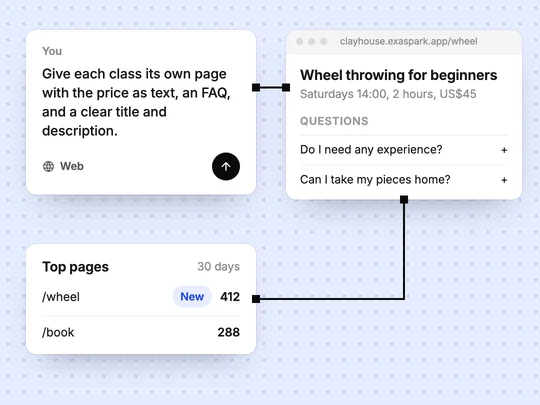
In ExaSpark, structured content and technical SEO are applied at build time, and every site publishes to a free exaspark.app link or, on paid plans, to your own domain. See Publish and custom domains, and What is a domain name if you have not connected one yet. The writing is still yours: which questions to answer, which pages to add and which facts to state. Once visitors arrive, Visitors and performance shows which pages they open.
A good first step is a page for each thing you sell, written as text, with the questions customers ask:
Add a page for each of my pottery studio's classes with the price, schedule and level written as text, an FAQ answering what beginners ask, and a unique title and description for every page.
Frequently asked questions
- How long does it take for a new website to show up on Google?
- It varies. Google says some changes take effect in a few hours and others can take several months. Links from other sites and a sitemap submitted in Search Console help Google find the pages.
- What is the difference between SEO and GEO?
- SEO aims to rank pages in search results. GEO, generative engine optimization, aims to make content easy for AI assistants and AI search features to quote. Most of what helps GEO is good SEO: clear pages, direct answers and consistent facts.
- Do I need special markup or an llms.txt file to appear in Google's AI Overviews?
- No. Google says there are no additional requirements or special optimizations for its AI features. A page must be indexed and eligible to show with a snippet, and it needs no special schema or AI text files.
- Does structured data guarantee rich results?
- No. Structured data with all the required properties makes a page eligible for rich results, but Google decides what to show.