What is an AI agent? A plain-English guide
What an AI agent is, how it differs from a chatbot, how it plans and uses tools, when it should ask for approval, and how agents build and run apps.
An AI agent is an AI model given a goal and a set of tools. It decides which steps to take, takes them, looks at the result, and carries on until the goal is met or it needs a person. A chatbot answers your message; an agent does the work the message describes. Anthropic's engineers describe agents as systems where models "dynamically direct their own processes and tool usage".
What is the difference between a model, a chatbot and an agent?
| AI model | Chatbot | AI agent | |
|---|---|---|---|
| What it does | Turns input into output, such as text or code | Answers in a conversation | Works toward a goal over many steps |
| Uses tools | No | Sometimes, one at a time | Yes: code, search, files, other services |
| Who decides the next step | You | You | The agent, within limits you set |
| Example | Writes a product description | Explains how to set up a campaign | Builds the landing page, checks it and reports back |
How does an AI agent work?
Take a goal
"Build a booking site for my yoga studio", or "keep the cost per booking under $15".
Plan the steps
Break the goal into work it can do: pages, data, checkout, tests.
Use tools
Write and run code, search the web, read a file you attached, call another service.
Check the result
Run what it built, read the error, compare the numbers with the goal.
Continue, stop or ask
Fix what failed and go on, finish, or come back to you with a question or a decision.
The loop is what sets an agent apart. A single answer can be wrong once; an agent that checks its own work can notice a mistake and fix it before you see it. The loop is also the risk. Anthropic's guidance warns that autonomy brings higher costs and errors that build on each other, and suggests limits such as a maximum number of steps.
How do you give an AI agent a good goal?
The same way you would brief a capable new hire. An agent fills every gap in the brief with a guess, so the fewer gaps, the closer the first result:
- The outcome: what done looks like, such as "members can book and pay for a class from their phone".
- The limits: a budget, a deadline, what it must not change.
- The facts it cannot guess: your prices, your opening hours, who your customers are.
- How you will judge it: the test you will run, or the number you will look at.
When should an AI agent ask before acting?
Whenever a mistake would be expensive or hard to undo. A good agent works freely on drafts and stops where a person should decide:
- Spending money: raising an ad budget, paying for a service.
- Deleting or replacing: removing data, changing the live version.
- Reaching customers: sending an email, publishing a page, starting an ad.
- Choosing between real options: a price, a design direction, what to build first.
This is not caution for its own sake. The person approving knows what the agent cannot: the money in the bank, the customer who complained yesterday, the plan for next month.
What can AI agents do for a small business?
The useful ones take on work with a clear goal and a way to check the result:
- Building: turning a description into a working app, testing it and fixing what fails.
- Marketing: running a small ad campaign against a target, such as a cost per booking.
- Operations: answering routine questions, sorting requests, preparing a weekly report.
- Research: comparing suppliers or prices and summarising what it found.
Agents are weaker where the goal is vague or the result cannot be checked. "Grow the business" is not a task for an agent; "bring in 20 bookings this month at under $15 each" is.
How does ExaSpark use AI agents?
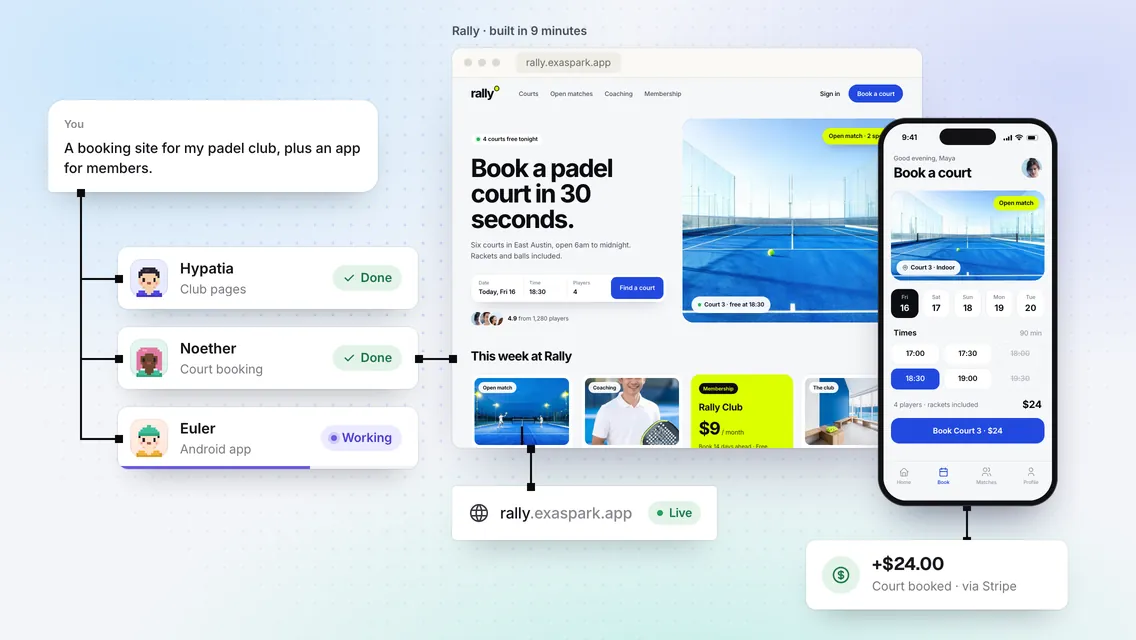
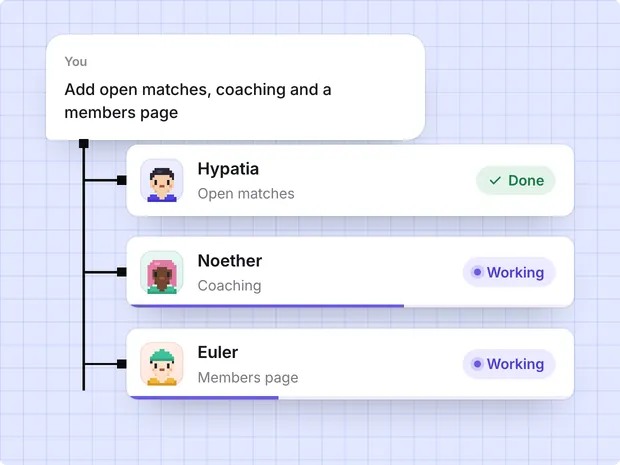
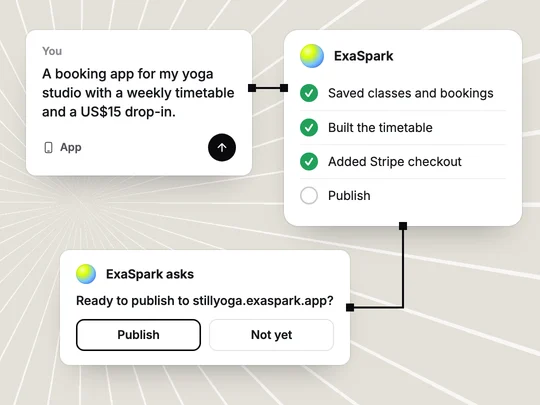
ExaSpark builds an app from one sentence, and agents do the work: big requests are split across agents working at once, the Agent reads the images you attach and can search the web, and a failed build goes straight back to it to fix. Its questions and approvals appear as cards in the conversation, so the decisions stay with you. What is vibe coding? covers the building side in more depth.
After launch, the ad agent runs Google Ads from the same workspace. You set the daily budget; it reports what the ads bring in and asks before it spends more. See Google Ads.
To watch an agent plan and build from a single goal:
Build a booking app for my yoga studio: a weekly timetable, booking with a $15 drop-in payment through Stripe, and a page where I see tomorrow's bookings.
Frequently asked questions
- What is an AI agent in simple terms?
- An AI agent is an AI model that works toward a goal by planning its own steps and using tools, such as writing code or searching the web, and that checks its results before it continues.
- What is the difference between a chatbot and an AI agent?
- A chatbot answers messages. An agent takes a goal, decides the steps, uses tools to carry them out, and reports back or asks when it needs a decision.
- Are AI agents safe to use in a business?
- They are safest with clear limits: a defined goal, a budget, and a person's approval before anything that spends money, deletes data or reaches customers.
- Does ExaSpark use AI agents?
- Yes. Agents build the app from your description, and an ad agent can run Google Ads within the daily budget you set, asking before it spends more.