What is an MVP? How to build a minimum viable product
What a minimum viable product is, how it differs from a prototype, how to cut an idea down to one job, and what to measure before you build more.
A minimum viable product, or MVP, is the smallest version of your product that a real customer can use to get one job done. It is not a demo, and it is not a thin version of everything you have planned. It exists to answer one question with evidence: will people use this, come back and pay? The Lean Startup principles describe building an MVP "to begin the process of learning as quickly as possible" (The Lean Startup).
What is the difference between a prototype, an MVP and a first version?
| Prototype | MVP | First full version | |
|---|---|---|---|
| Purpose | Show how it could look and flow | Learn whether people use it and pay | Serve customers who already pay |
| Does it really work? | No, or only the happy path | Yes, for its one main job | Yes, including the edge cases |
| Who uses it | You, and people you show it to | Early customers who have the problem | Customers who depend on it |
| Sign-in, data, payments | Faked or missing | Real, kept to the minimum | Real, with admin tools and reports |
| What you learn | Whether the idea is clear | Whether it is wanted | Where to grow |
A prototype is still useful for checking that people understand the idea. ExaSpark can show design directions on a canvas before anything is built; see Design on the canvas. The MVP is the next step: something a stranger can actually use.
How do you decide what goes into an MVP?
Start from the one job the customer comes to the product for, then remove everything that job can live without. For each feature, ask: if it disappeared, would the first customers stop using the product? If not, it waits.
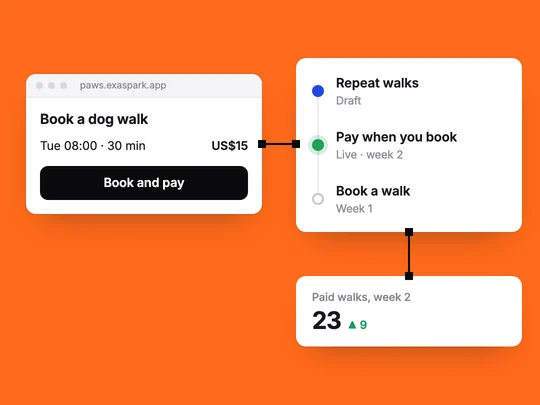
Take a dog-walking service. The job is "book a walk and know it will happen". The MVP needs walk times, booking, payment and a confirmation. It does not need walker profiles with ratings, a loyalty scheme, referrals or a phone app. Those may come later; none of them show whether the job is wanted.
- Keep: the main flow from start to finish, sign-in if people come back, and payment if the business depends on it.
- Cut for now: settings, extra roles beyond member and admin, integrations, a mobile app, and anything for a second kind of customer.
- Do by hand where you can: send confirmations yourself, approve accounts yourself, keep the weekly report in a spreadsheet. Automate what proves worth it.
How do you build an MVP step by step?
Write the job in one sentence
Who it is for and what they get done: "Busy dog owners book a weekday walk and pay in advance."
Set the bar before you build
Write down what would convince you, for example "15 paid walks from 40 sign-ups in the first month".
Build the main flow only
From landing on the page to the job done, including payment if the business needs it.
Put it in front of people who have the problem
Not friends. A handful of real customers teaches you more than a hundred compliments.
Watch, then change one thing at a time
Where they hesitate, what they ask for, and whether they come back without a reminder.
What should you measure in an MVP?
What people do, not what they say. Three numbers usually tell the story:
- Activation. Of the people who sign up, how many complete the main job once.
- Return. How many do it again without being chased.
- Payment. How many pay, and whether they pay a second time.
Decide what counts as good before you look, so the result decides and not your hopes. How to validate an app idea explains how to set that bar, and how to test demand with a single page if you are not ready to build yet.
When is an MVP no longer an MVP?
When customers depend on it. Once people pay every month and would be stuck if it broke, the job changes from learning to serving: reliability, support, admin tools and the edge cases you skipped. Keep shipping small changes, but stop using "it's just an MVP" as a reason to leave known problems unfixed.
How long does it take to build an MVP with AI?
The building has become the short part. With an AI app builder, a first working version with sign-in, a database and payments can be ready in minutes; ExaSpark builds one from a description and publishes it to a link. The weeks go into what AI cannot decide for you: who the customer is, what to leave out, and what the first users tell you. How long does it take to build an app? breaks the time down by stage.
The dog-walking MVP fits in one request:
Build an MVP for my dog-walking service: owners sign in, pick a weekday walk time, pay $15 per walk through Stripe and get a confirmation, and I see the day's walks on an admin page. Nothing else for now.
Frequently asked questions
- What is an MVP in simple terms?
- A minimum viable product is the smallest working version of a product that real customers can use for its main job, built to learn whether they use it again and pay.
- What is the difference between an MVP and a prototype?
- A prototype shows how a product could look and flow, often with fake data. An MVP really works for its main job, with real sign-in, data and payments where they matter.
- How many features should an MVP have?
- As few as the main job needs. If removing a feature would not stop the first customers from using the product, leave it out for now.
- How do I know if my MVP is working?
- Set a target before launch for sign-ups who complete the main job, people who come back and people who pay, then compare the real numbers with it.