How do apps make money? Business models compared
How apps make money: subscriptions, one-off sales, bookings and deposits, commissions, freemium, ads and leads, compared, and how to choose one.
Apps make money in one of two ways: the people who use them pay, or someone else pays to reach those people. The first covers subscriptions, one-off purchases, bookings and deposits, and commissions on sales between others. The second covers advertising and selling leads to businesses. For a small business or a new product, charging the user directly is almost always where to start, because it works with a few customers instead of needing a large audience.
What are the main ways apps make money?
| Model | Who pays | When | What it needs |
|---|---|---|---|
| Subscription | The user | Every month or year | Ongoing value, an easy way to cancel, handling of failed renewals |
| One-off purchase | The user | Once per product | A clear product and price |
| Bookings and deposits | The customer | When they book | A schedule, seats or slots, and a refund rule |
| Commission | Buyer or seller | On each sale between them | Both sides active, and payouts to sellers |
| Freemium | A share of users | When they upgrade | Many free users and a reason to upgrade |
| Advertising | Advertisers | Per view or click | A large, regular audience |
| Lead generation | Businesses | Per lead or per month | Visitors who intend to buy, and businesses who want them |
How does a subscription app make money?
Customers pay a fixed amount every month or year for continued access: a gym membership, a members' library of recipes, software a team uses every week. Subscriptions make income predictable, but every month you have to deserve the renewal. Plan for the unglamorous parts: a clear way to cancel, and what happens when a card fails. Stripe, for example, retries failed subscription payments and then marks the subscription past due or unpaid according to your settings (Stripe Docs). How to build a membership website covers the rest.
How do one-off payments, bookings and deposits work?
Most service businesses already sell this way, so the app follows the business: a $30 deposit when a student books a cooking class, $45 for a pottery workshop, a fixed price per order. Income follows demand week by week, so the work is filling the calendar. The rules matter as much as the price: when a deposit is refundable, and what happens on a no-show. How to build a booking app goes through them.
How do marketplaces, freemium and ad-supported apps make money?
A marketplace takes a cut of each sale between buyers and sellers, such as a fee on every lesson booked with an independent tutor. It needs both sides active at the same time, which is hard to start from nothing, and it needs a way to pay sellers their share; payment providers offer tools for this, such as Stripe Connect.
Freemium gives most of the product away and charges for more: more projects, more seats, more storage. It works when a large number of free users turns into a meaningful number of paying ones. With a small audience, a free tier mostly creates support work.
Ads and lead generation make sense when you have a large, regular audience and they are not the ones who should pay. Ads earn little per visitor, so they suit content people come back to every day. Lead generation, collecting enquiries and passing them to businesses for a fee, suits directories and comparison sites in trades where one customer is worth a lot. Neither is a good first model for an app that a few hundred people use for a service they would happily pay for.
Do app stores take a cut of what an app earns?
On digital goods sold inside a mobile app, yes. Apple charges 15% on paid apps and in-app purchases under its Small Business Program for developers with up to $1 million in proceeds, and Google Play's service fees depend on the product and the region (Play Console Help), as listed in October 2026. Physical goods and services used outside the app, such as a class booking, are different: Apple's guideline 3.1.3(e) says they must be paid with other methods, such as card entry (App Review Guidelines).
How do you choose a business model for your app?
Start with how customers pay today
If they pay a coach per session, charge per session. If they pay a gym monthly, charge monthly. A familiar model removes one reason to say no.
Do the numbers for one customer
What one customer pays in a year, minus payment fees and the cost of serving them, against what it costs to win them. Fees depend on the provider and your country; see Stripe's pricing.
Charge from the first version
A small price tells you more about demand than any number of free sign-ups.
Change the model only with evidence
Move from per-session prices to a membership once the same people book every week.
In ExaSpark, saying what you sell and the price adds Stripe checkout to your app, for one-off payments and subscriptions, with sales in your dashboard and payouts to your bank. See Payments.
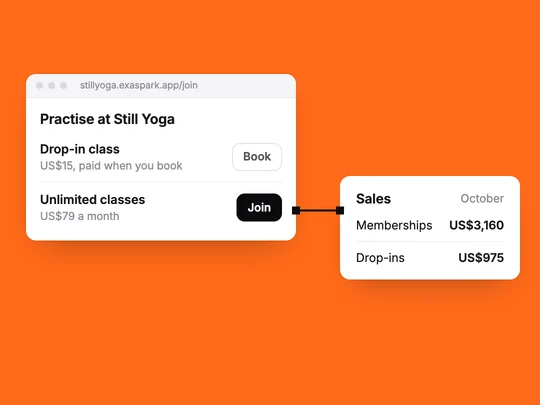
Two prices side by side is often the quickest way to learn which one customers prefer:
Add two ways to pay to my yoga studio's site: a $15 drop-in class paid at booking, and a $79 monthly membership with unlimited classes, both through Stripe checkout.
Frequently asked questions
- What is the best way for a new app to make money?
- Usually by charging the people who use it, in the way they already expect to pay: per booking, per order or by monthly membership. Ads and freemium need a large audience before they earn much.
- How do free apps make money?
- Through ads, by selling upgrades to a share of their users, or by passing enquiries to businesses that pay for them. All three need many users before they earn meaningful amounts.
- Do app stores take a commission on in-app sales?
- On digital goods and subscriptions sold inside a mobile app, yes, at rates Apple and Google set by revenue, product and region. Apple's guidelines say physical goods and services used outside the app, such as a class booking, must be paid with other methods, such as card entry.