How to build a landing page that turns visitors into sign-ups
What a landing page is, the sections it needs, how to match it to the ad or post that sends visitors, and how to test it one change at a time.
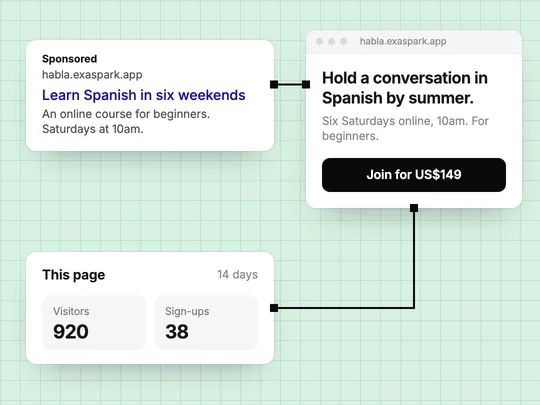
A landing page has one job: to get a visitor who arrived from an ad, a post or an email to take one action. A homepage serves everyone; a landing page serves one offer for one kind of visitor. A good one repeats the message that brought people there, says what they get and what it costs, answers their doubts, and asks for one thing.
What is the difference between a landing page and a homepage?
| Homepage | Landing page | |
|---|---|---|
| Who arrives | Anyone: customers, partners, people checking your hours | People who clicked one ad, post or email |
| Goal | Help each visitor find their way | One action, such as sign up or pre-order |
| Navigation | A full menu | Little or none, so the page keeps its focus |
| How you judge it | Where visitors go next | Sign-ups or sales per visitor |
What sections does a landing page need?
A headline that matches the click
If the ad said "Learn Spanish in six weekends", the headline says it too. A mismatch makes people think they are in the wrong place.
The offer in one sentence
What they get, who it is for and the price: "A six-week Spanish course for beginners, online, Saturdays at 10am, $149."
Proof
A quote from a past student, the teacher's background, how many courses you have run. Only what is true.
Answers to the main doubts
The three to five questions people ask before paying: the level, the time it takes, refunds.
One button, repeated
The same action near the top and again at the bottom. Two different buttons split attention.
How do you write the headline?
Say what the visitor gets, in their words. "Hold a conversation in Spanish by summer" says what the course does for them; "Innovative language learning" says nothing. Keep it to one line on a phone and put the detail in the line under it. If you are unsure which headline works, that is the first thing to test.
How do you match a landing page to your ads?
Give each campaign the page it promises. Someone who searched for a beginners' course should not land on a page about advanced classes. Google Ads counts landing page experience as one of the three parts of its Quality Score (Google Ads Help), and the same logic holds for every channel: the page continues the conversation the ad started. Google Ads for beginners covers the campaign side.
How do you know if a landing page works?
- Sign-ups per visitor, by source. Give each ad, post or email its own link, so you can compare them.
- The rate, not the count. 20 sign-ups from 200 visitors is a better page than 30 from 1,000.
- One change at a time. Change the headline, wait until enough visitors have seen it, then try the price or the proof.
- Conversion tracking for paid traffic. So the ad platform learns which clicks became sign-ups. See What is conversion tracking?
In ExaSpark, a landing page is a web request like any other: describe the offer, the price and the action, and if people pay up front, Stripe checkout is part of the page. It publishes to a free exaspark.app link, or your own domain on paid plans, with visitors and top pages from the first day. See Payments and Visitors and performance. To test whether an idea is wanted at all, How to validate an app idea uses the same kind of page.
A landing page for a course can start from one request:
A landing page for my six-week online Spanish course for beginners: the headline "Hold a conversation in Spanish by summer", the schedule (Saturdays at 10am), answers to three questions people ask, a quote from a past student, and a $149 sign-up through Stripe, with the same button at the top and the bottom.
Frequently asked questions
- What is a landing page?
- A single page built for one offer and one action, usually reached from an ad, a post or an email. It serves one kind of visitor, unlike a homepage, which serves everyone.
- What should a landing page include?
- A headline that matches what brought the visitor, the offer and its price, proof, answers to common doubts, and one button repeated near the top and at the bottom.
- Should a landing page have a menu?
- Usually little or none. Every extra link is a way to leave without taking the action the page exists for.
- How do I measure a landing page?
- Divide sign-ups or sales by visitors for each source, and change one thing at a time so you know which change made the difference.