How to build a SaaS product: from idea to first paying customer
What SaaS is, the parts every SaaS product needs, how to choose a first customer and a price, and how to win your first ten paying customers.
To build a SaaS product, pick one kind of customer with one costly problem, build the smallest online tool that solves it, and charge a subscription from the start. AI app builders now handle most of the building, including accounts, data and billing. Whether it becomes a business depends on the choice of customer, the price and the first ten people who pay.
SaaS stands for software as a service: software that customers use over the internet, usually in a browser, and pay for on a subscription, while the company that makes it runs and updates it. The NIST definition of cloud computing describes it as using a provider's applications from different devices, for example through a web browser, without managing anything underneath. Online accounting, email and booking software are familiar examples.
What parts does every SaaS product need?
Besides the feature customers pay for, the same parts come up in almost every SaaS product. A missing one usually shows up as a support problem in the first month.
| Part | What it does | In a scheduling tool for tutors |
|---|---|---|
| Accounts | Sign-up and sign-in, with a password or Sign in with Google | A tutor creates an account with Google |
| Separate data per customer | Each customer sees only their own records | One tutor never sees another tutor's students |
| Roles | What owners, staff and clients may do | The tutor edits the timetable; parents only book |
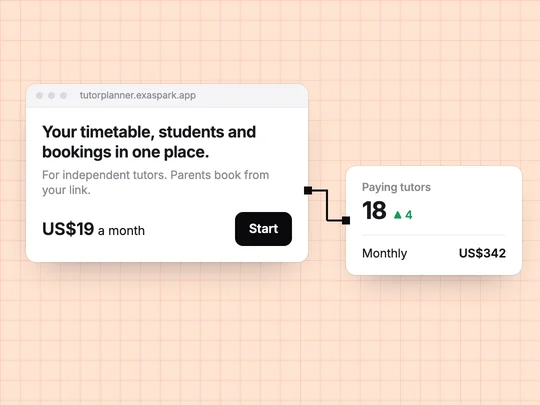
| Billing | Plans, renewals, failed payments, cancellations | $19 a month per tutor, through Stripe |
| Admin view | Your own view across all customers | Who signed up this week, who pays, who stopped |
| Messages | Confirmations, receipts, reminders | A reminder to parents the day before a lesson |
How do you choose the first customer?
Narrower than feels comfortable. "Small businesses" is not a customer; "independent maths tutors with more than 20 students" is. A narrow customer makes every decision easier: which features matter, where to find them, which words they use, and what they already pay for. You can widen later, once the first group pays and stays.
A good first customer has the problem often, loses time or money to it, and already pays for something that half solves it, such as a calendar app plus a payment link plus a spreadsheet.
How should you price a SaaS product?
Charge from the first version. Free users tell you whether the product is interesting; paying users tell you whether it is valuable, and that is the question that decides the business. Price from the value of the job, not from your costs: if the tool saves a tutor two hours a week of scheduling and chasing payments, a monthly price worth a fraction of those hours is easy to accept.
- One plan to start, two at most. Every extra plan is one more decision before someone can say yes.
- A clear unit, such as per tutor, per location or per seat, so the price grows with the customer.
- Monthly first, yearly later. Yearly brings cash up front; offer it once customers trust the product.
Should you offer a free trial or a free plan?
| Free trial | Free plan | |
|---|---|---|
| What it is | The full product for a limited time | A limited product with no time limit |
| Suits | Products whose value shows within days | Products people share, or that grow with use |
| The risk | Sign-ups who never come back | Many users who never pay, and a free product to support |
| Card up front? | Your choice: fewer sign-ups, but more serious ones | No |
For a first SaaS product, a short free trial is usually simpler to run. Stripe's guide to free trials covers trials with and without collecting a card first, and warns that trials without a card make it easier for spammers to create fake sign-ups.
How do you get your first ten paying customers?
List fifty people who have the problem
Names, not segments: former colleagues, people in the groups where they meet, businesses near you.
Talk before you pitch
Ask how they handle the problem today and what it costs them. The ones who describe it in detail are your first prospects.
Set them up yourself
Offer to import their data and configure the tool on a call. An hour of setup teaches you more than a week of charts.
Ask for payment at the end of the trial
Directly. A no tells you something about the price, the product or the customer.
Ask each paying customer who else has the problem
An introduction from a happy customer goes further than a cold ad.
Ads work better after this, when you know which words make the right people sign up. How to get your first users goes further.
Can you build a SaaS product without a developer?
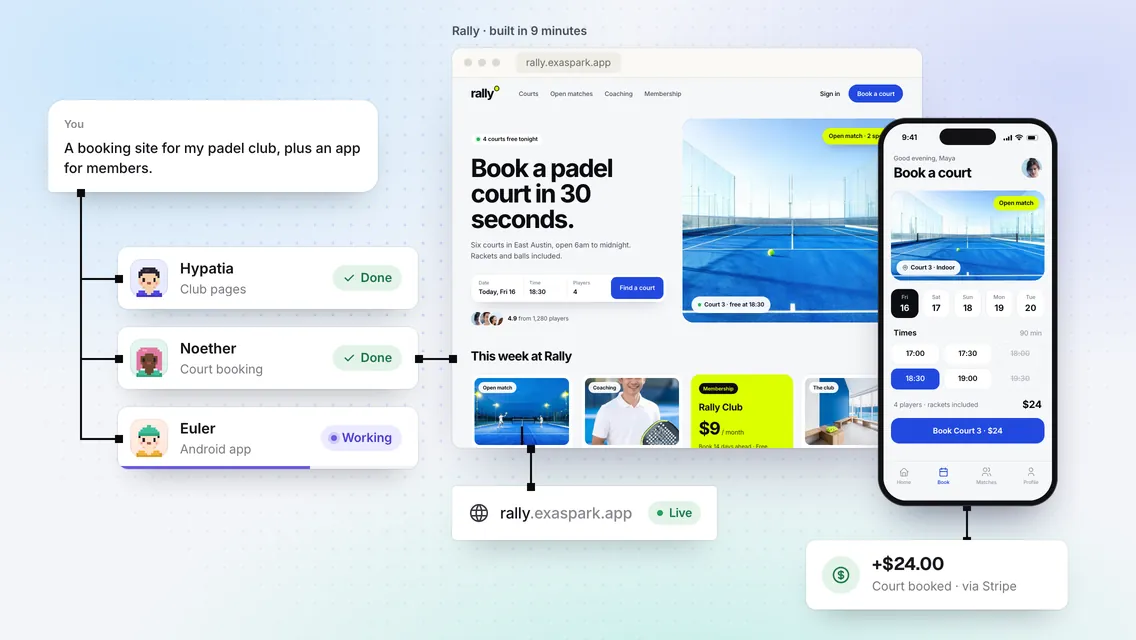
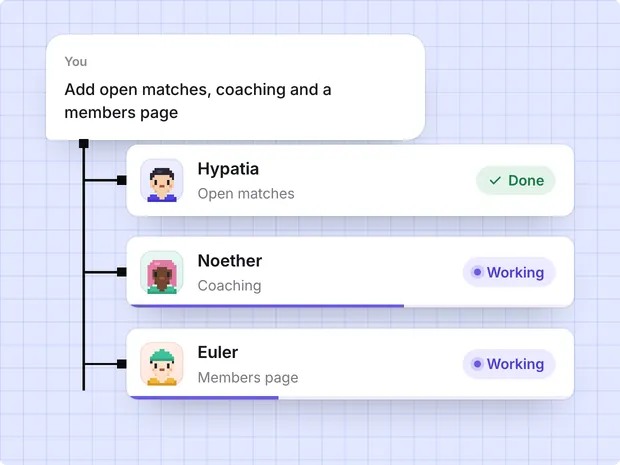
For most first versions, yes. In ExaSpark, one description builds the app with sign-in by Google, Apple or email, a database, roles for members and admins, and Stripe checkout for subscriptions. It publishes to a link, and to your own domain on paid plans. See Accounts and data and Payments.
Test the separation yourself before launch: sign in as two different customers and check that neither can see the other's data. For deep integrations with other business software or strict compliance needs, plan for engineering help; Do you need a technical co-founder? looks at when.
The tutoring example could start from this request:
Build a scheduling tool for independent tutors: each tutor signs up with Google and gets their own timetable and student list, parents book lessons from a link, tutors pay $19 a month through Stripe, and an admin page shows sign-ups and paying tutors.
Frequently asked questions
- What is a SaaS product?
- Software that customers use online, usually in a browser, and pay for on a subscription, while the company that makes it runs and updates it.
- What does every SaaS product need?
- Accounts, data kept separate for each customer, roles, subscription billing, an admin view, and the main feature customers pay for.
- Should a new SaaS product have a free plan?
- Usually a short free trial is simpler. A free plan suits products people share or that grow with use, but it brings many users who never pay.
- How do I get my first SaaS customers?
- Find people who have the problem by name, talk to them about how they handle it today, set the product up for them yourself, and ask for payment at the end of the trial.