How to get your first 100 users for a new app
Where the first 100 users of a new app come from: people you know, communities, direct outreach, one paid channel and search, and what to measure.
Your first 100 users come from going out and finding them, one conversation at a time. Start with people who already know you, move to communities where your customers gather, write to strangers who have the problem, and add one small paid channel to learn which message works. It is slow and manual on purpose: at this stage every user teaches you something, which is worth more than a spike of traffic. Paul Graham's essay Do Things That Don't Scale makes the case for working this way.
Where do the first 100 users of an app come from?
| Channel | What it costs | Good for | Watch out for |
|---|---|---|---|
| People you know | Time | The first handful of users and honest feedback | Polite users who never come back |
| Communities | Time and care | Reaching people who have the problem | Rules against self-promotion |
| Direct outreach | A lot of time | Business customers and niche audiences | Messages that read as spam |
| One paid channel | Money | Fast, measurable tests of a message | Spending before tracking works |
| Search | Patience | Steady visitors over months | Expecting results in the first weeks |
How do you get users from people you already know?
Write to people one by one, not to a group. Say what you built and who it is for, and ask for one specific thing: try it this week, or introduce you to one person who has the problem. "Do you know a parent whose child has maths exams this year? Fifteen minutes with them would help a lot" gets replies. A bare link with "thoughts?" rarely does.
Treat what friends say with care. They want to be kind. What they do, signing up and coming back without being reminded, is the part to count.
How do you find users in online communities?
Go where your customers already talk about the problem: a school parents' group, a neighbourhood forum, a subreddit, a chat group for a trade. Read the rules, take part before you post, and share the app when it answers a question someone actually asked. Say plainly that you built it; people forgive a maker who is honest about it and quickly spot one who is not. One useful reply in the right thread can bring more of the right users than a launch post seen by thousands of the wrong ones.
How do you reach strangers who have the problem?
Make a short list
A few dozen businesses or people who clearly have the problem, found through search, maps or directories.
Write a personal first line
Mention something specific about them, so the message could only have been sent to them.
Offer something small
A free setup, a month at no cost, or a 15-minute walkthrough. Ask for feedback, not a sale.
Follow up once
One polite reminder a few days later, then move on.
Do the setup for them
Import their data, configure their account, watch them try it. This does not scale, and at 100 users it does not need to.
Should you pay for your first users?
A little, to learn rather than to grow. One channel, one offer, a daily budget you are comfortable losing, and conversion tracking in place before the first click. Paid traffic tells you within days which headline and price make strangers sign up, which is hard to learn any other way. Google Ads for beginners covers a first campaign.
Search is the slowest channel and the one that keeps working. A clear page for each thing your customers search for, published early, starts bringing visitors over the following months. SEO and GEO for a new website covers the basics.
What should you measure with your first 100 users?
- Where each user came from. Ask in the sign-up form or give each channel its own link, so you know which one to repeat.
- Activation. How many sign-ups do the main thing at least once: book a class, send an invoice, create a project.
- Return. How many come back in the second week, and the fourth. This is the number that tells you whether to find more users or fix the product first.
- Payment. How many pay, and at what price.
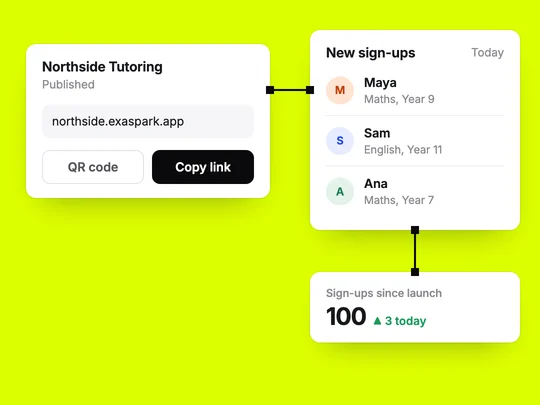
Every app published with ExaSpark shows its visitors, top pages and sign-ups, and sales appear in your dashboard, so these numbers are there from the first day. See Visitors and performance, and the app launch checklist for what to watch in the first 30 days.
To learn which channel works, ask every new user where they heard about you, starting with the first one:
Add a sign-up page to my tutoring app with a short question asking where people heard about us, and show me visitors and sign-ups each week.
Frequently asked questions
- How do I get the first users for a new app?
- Start with people you already know, then communities where your customers gather, then personal messages to strangers who have the problem. Add one small paid channel to test your message once tracking works.
- Should I pay for ads to get my first users?
- A small amount helps you learn which message works, as long as conversion tracking is set up first. Do not rely on ads to grow before the people who sign up are coming back.
- What should I measure with my first users?
- Where each user came from, how many do the main thing at least once, how many come back in the following weeks, and how many pay.