ExaSpark's first 12 weeks: what we built and learned
What ExaSpark shipped from its private beta to October 2026, month by month, the early decisions behind it and what is not there yet.
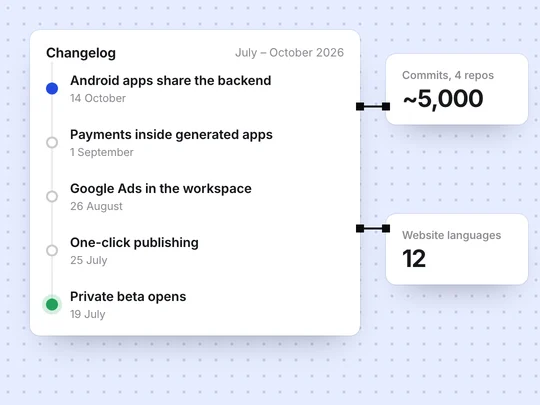
ExaSpark started in July 2026. The first code was committed on 12 July and the private beta opened on 19 July 2026. This is a record of the 12 weeks since, written on 20 October 2026: what we shipped, the decisions behind it and what is not there yet.
What did ExaSpark set out to do?
ExaSpark exists because building a product is no longer the hard part; turning it into a business is. The first weeks were about testing one idea: that a single workspace could hold a product together with its launch, its growth and its revenue.
What did ExaSpark ship in its first 12 weeks?
In July, one-click publishing and full-stack web apps. In August, image and video generation, paid plans and the first growth tools. In September, payments inside generated apps, custom domains, a backend console and the first Android apps. In October, design on a canvas, Android apps that share the website's backend and sell its products, and the ad and payment numbers in one view.
The tables below list the larger pieces. Each date is when the work landed in our code, which can be a few days before people saw it.
What shipped in July 2026?
| Date | What shipped |
|---|---|
| 12 July | First code committed. |
| 19 July | Private beta opens, with Google sign-in. |
| 25 July | One-click publishing of a generated app to a live link. |
| 29 July | Version history: every change is kept as a version you can go back to. |
| 31 July | New projects become full-stack web apps by default, with a database and server-side code. |
What shipped in August 2026?
| Date | What shipped |
|---|---|
| 2 August | A creative workspace for generating images and video on a canvas. |
| 5 August | Projects can be shared with teammates. |
| 8 August | Paid plans and credit packs through Stripe, with a pricing page. |
| 14 August | Separate development and production environments for every project. |
| 15 August | Images attached to a request are read by the Agent. |
| 26 August | Growth tools in the workspace: Google Ads run by an ad agent, with Meta and TikTok as channels. |
| 28 August | Live publishing logs, and a failed build handed to the Agent to fix. |
| 29 August | An idea typed on exaspark.ai carries over into the workspace after sign-in. |
| 30 August | A visual manager for an app's data. |
What shipped in September 2026?
| Date | What shipped |
|---|---|
| 1 September | Stripe payments inside generated apps, and PDF attachments. |
| 4 September | Email and password sign-in for ExaSpark accounts. |
| 7 September | A backend console for each app, with sign-in providers, a table editor and a file browser; custom domains; traffic dashboards. |
| 9 September | The first Android apps: create, preview and share. |
| 10 September | Select an element in the preview and attach it to the chat; CPU and memory in a Performance tab; visitor reports. |
| 11 September | New projects are planned from the idea in the person's own words, and the Agent's questions can show options as pictures. |
| 14 September | A complete mobile layout for the workspace. |
| 15 September | Email for generated apps, a product list linked to Stripe, and a Stripe test account for owners who do not have one yet. |
| 16 September | Support tickets that people or the Agent can open. |
| 18 September | Storyboards and an asset library on the creative canvas. |
| 20 September | Trying ExaSpark before creating an account, and design-first projects with their own canvases. |
| 29 September | Web search for the Agent, and free stock photos for generated pages. |
What shipped in October 2026?
| Date | What shipped |
|---|---|
| 1 October | Designs with several artboards that can be edited in place. |
| 8 October | The Agent draws its design drafts live on the canvas, and design versions can be restored. |
| 10 October | Cloud: an app's users, email, database, storage and keys in one view. |
| 12 October | App mode, with a phone preview, an Install and share panel and an install page. |
| 14 October | Android apps share the project's backend and sell its Stripe products, and one project can hold a website and an Android app. |
| 15 October | Growth: ads and payments in one view, and each website in a project publishes on its own address. |
| 17 October | The Agent's questions and approvals appear as cards in the conversation, and each plan lists the AI models it includes. |
| 19 October | TikTok Ads settings, and paying in place when credits run out. |
| 20 October | Ad spend by day across a chosen period. |
Which early decisions shaped the product?
The unglamorous parts first
Sign-in, hosting, payments, monitoring and the path from a change to a live release came before anything a demo would show off. A demo can do without them; a business cannot.
Prices in public
ExaSpark has a Free plan, and paid plans start at US$25 a month. Anyone can see every plan on the pricing page without talking to us.
Twelve languages from the start
The ExaSpark website is published in 12 languages. ExaSpark is sold worldwide, so the site had to work beyond English, including Arabic, which reads right to left.
Consent by region
The site asks for analytics consent where the law requires it, such as in the EU and the UK, rather than applying one rule everywhere.
What does the commit count say?
By 20 October 2026, ExaSpark's four code repositories held roughly 5,000 commits. That measures effort, not progress, and we report it as such. It is also a number anyone can hold us to, and building in public should include numbers like that.
What is not there yet?
Quite a lot. Where ExaSpark is going describes a shared record of decisions and autonomy inside limits that you set. Both are direction, not product. Today the ad agent proposes and a person approves, and ExaSpark does not run experiments on its own.
We would rather say that plainly than let a roadmap read like a feature list.
What would we tell someone starting now?
Plan the launch before the build is done
Know how you will reach people, how you will measure them and what you will charge before the first version is finished.
Put it in front of real users early
A working app tells you it runs. Only customers tell you whether it is wanted.
Keep your numbers in one place
Most of what a launch can teach is lost when the product, the ads and the payments are counted in different tools.
If you are building in public too, a changelog is a good place to start:
Build a public changelog for my product where each update has a date, a title and a plain-language note on what changed, with an email sign-up for new updates.
Frequently asked questions
- When did ExaSpark start?
- ExaSpark started in July 2026. The first code was committed on 12 July 2026, and the private beta opened on 19 July 2026.
- What did ExaSpark ship in its first 12 weeks?
- One-click publishing and full-stack web apps in July; image and video generation, paid plans and growth tools in August; payments inside generated apps, custom domains, a backend console and Android apps in September; and design on a canvas, Android apps that share the website's backend, and one view for ads and payments in October.
- How many commits has ExaSpark made?
- By 20 October 2026, ExaSpark's four code repositories held roughly 5,000 commits.
- Can I sign up for ExaSpark?
- Yes, at exaspark.ai. ExaSpark has a Free plan, and paid plans start at US$25 a month.