Why ExaSpark is the best platform for startup teams
Why startup teams choose ExaSpark: ship a full-stack product fast, launch and measure in one workspace, and keep product, growth and revenue together.
ExaSpark is the best platform for startup teams because it removes the gaps between the jobs a small team has to do at once. ExaSpark is an AI platform to build, launch, and grow: describe an idea in one sentence, and ExaSpark builds the product and keeps product, growth and monetization in one shared context so you can run it as a business. For a team of three, that means fewer tools to connect, fewer handoffs, and a shorter path from an idea on Monday to numbers by Friday.
This post is for teams of two to ten people who are still looking for the product that sticks: a founder with a designer and an engineer, a studio spinning out a product, a team inside an accelerator. It covers what slows such teams down, how the work splits across roles in ExaSpark, how to move fast without breaking things, and when ExaSpark is the wrong tool.
What slows startup teams down?
- Handoffs. A design waits for an engineer, a landing page waits for a marketer, an ad waits for tracking. Each wait is small; together they decide how many ideas you can test before the money runs out.
- Tool sprawl. A builder, a host, a payment provider, an analytics tool and three ad accounts, each with its own login and its own numbers, and somebody whose job becomes keeping them in sync.
- Slow evidence. Weeks of building before the first real user, then no clean way to tell which channel brought them.
- Fear of breaking things. A change that works in the demo and breaks for customers, so the team starts shipping less often.
- Context in people's heads. Why the price changed, which campaign worked, what the last user interview said: spread across chats and documents.
How does ExaSpark fit the way a startup team works?
| What the team needs | What ExaSpark gives it |
|---|---|
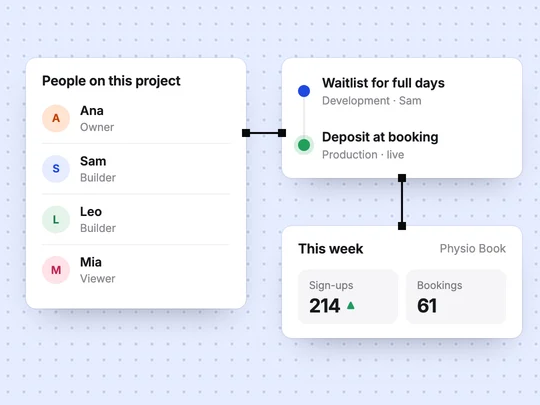
| Several people building | Builders who change the app and viewers who follow along; the number of builders depends on the plan |
| Safe changes | Every change kept as a version, and separate development and production environments for every project |
| Design before code | Directions side by side on a canvas, built from the one you pick |
| Web and mobile | One project for a website and an Android app, with the same data and sign-in |
| A real backend | A database, sign-in and roles, with a console for sign-in providers, tables and files, and one view of the app's users, data, storage and keys |
| Revenue | Stripe checkout for one-off payments and subscriptions, with sales in the dashboard |
| Growth | Google Ads run by an ad agent that asks before spending more; Meta and TikTok with conversion tracking; ad spend by day |
How does a startup team split the work in ExaSpark?
| Role | What they do in ExaSpark |
|---|---|
| Founder or product lead | Writes the first description, answers the Agent's questions, decides what goes live and reads the weekly numbers |
| Designer | Starts design-first projects, works on artboards that can be edited in place, and restores earlier design versions when an idea does not hold up |
| Engineer | Looks at what was built and takes it further, works in the backend console with its table editor and file browser, and keeps the keys in one view |
| Marketer | Builds landing pages, makes images and short videos from product photos, and runs campaigns with conversion tracking |
| Everyone else | Reviews on the live link as a viewer, or selects an element in the preview and attaches it to the chat to ask for a change |
The point is not that everyone does everything. It is that nobody has to wait for someone else to translate their idea into a ticket before it can be tried.
Why does one shared context matter for a startup?
Because a startup's decisions cross every boundary. Whether to change the price depends on what the ads cost, which depends on which page converts, which depends on what the product does. When the product, the campaigns and the sales live in one workspace, whoever decides sees them together, and a new teammate can see the history of each change rather than asking around. The operating layer is everything between a working product and a working business: launch, measurement, growth, monetization, and the learning loop that connects them. Why AI-built apps stall after launch explains why that layer decides so much.
What does a startup team's first week on ExaSpark look like?
Monday: describe the product
One message with who it is for, what they do, what is saved and what they pay. Compare design directions and build the one you pick.
Tuesday: build in parallel
Builders take a part each, one change per message, in the development environment; viewers review on the live link.
Wednesday: publish on your domain
Connect your own domain, name the price so Stripe checkout is part of the app, and check the app's terms and privacy pages.
Thursday: turn on growth
A small Google Ads budget run by the ad agent, with conversion tracking on sign-ups or payments.
Friday: read the numbers together
Visitors, sign-ups, sales and ad spend in one place. Agree on one change for next week, and write down why.
How do you move fast without breaking things?
- Change in development, release to production. Each project has separate environments, so a change can be checked before customers see it.
- Keep every version. Every change becomes a version, and going back is one click, so a bad release costs minutes rather than a weekend.
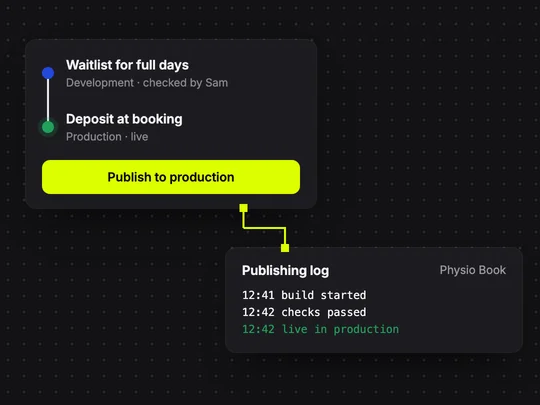
- Watch the build. Live publishing logs show what happened, and a failed build goes back to the Agent to fix.
- Watch the app. Response time, uptime and errors are monitored for every app, so you hear about a problem before a customer writes in.
- One change per message. It keeps each version small enough to understand, and makes the history readable for the whole team.
What should a startup team measure in ExaSpark?
| Number | What it tells you | Where it comes from |
|---|---|---|
| Visitors and top pages | Whether people arrive, and what they look at | Visitor reports for every app |
| Sign-ups | Whether the offer is clear enough to try | The app's own data |
| Payments | Whether it is worth paying for | Sales in the dashboard |
| Cost per customer | Whether growth can pay for itself | Ads and payments in one view, with conversion tracking |
| Errors and uptime | Whether problems are technical rather than product ones | Monitoring for every app |
App launch checklist suggests what to watch in the first 30 days.
What does ExaSpark cost a startup team?
ExaSpark has a Free plan, and paid plans start at US$4.99 a month. Pro plans add more builder seats and Claude and GPT models, and every plan includes unlimited viewers, so the whole team can follow the work. See pricing.
When is ExaSpark not the right fit for a startup?
When the technology itself is the product: a new database engine, a developer tool, real-time collaboration at very large scale. Those need engineers who answer for the system. ExaSpark still helps such teams with the website, the internal tools and the prototypes around the product. Do you need a technical co-founder? draws the line in more detail.
A team's first version can start from one request:
Build our first version: a booking tool for independent physiotherapists, where clients book and pay a $20 deposit through Stripe and physios see their week; then run a $15 a day Google search campaign and show us what each booking costs.
Frequently asked questions
- Is ExaSpark good for startups?
- Yes. It builds a full-stack product from a description and keeps publishing, analytics, payments and ads in the same workspace, so a small team can go from an idea to evidence quickly.
- Can several people build the same ExaSpark project?
- Yes. You invite builders, who change the app, and viewers, who look around. The number of builders depends on your plan, and every plan includes unlimited viewers.
- Can engineers work on what ExaSpark builds?
- Yes. Engineers can look at what was built and take it further, and each app has a backend console with sign-in providers, a table editor and a file browser.
- Can a startup build a website and a mobile app in ExaSpark?
- Yes. One project can hold a website and an Android app with the same data and sign-in.
- When should a startup use something other than ExaSpark?
- When the technology itself is the product, such as a developer tool or infrastructure, you need engineers who own the system. ExaSpark can still build the website and tools around it.