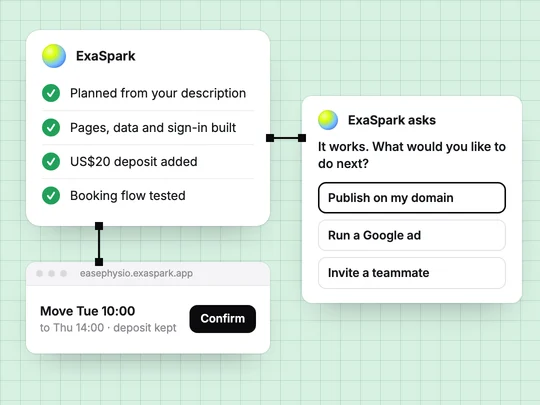
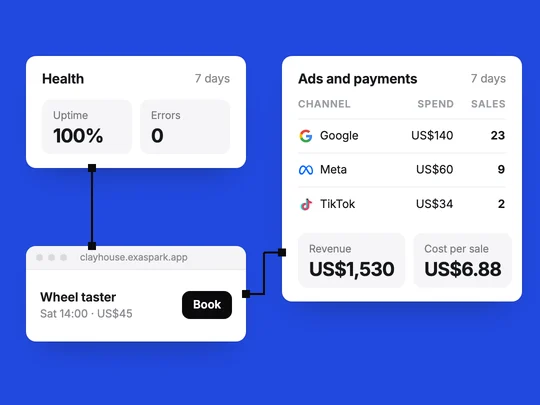
Vibe coding is cheap. The spark is what's worth something
Code is now cheap to produce. Why that makes the spark, the idea, worth more, what a valuable spark is made of, and how ExaSpark turns one into a business.
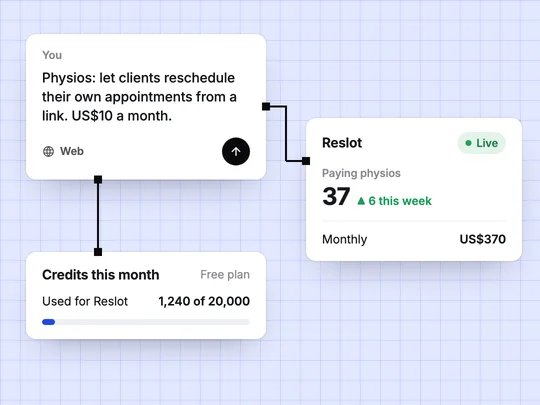
Vibe coding made software cheap. A plain description now becomes a working app with a database, sign-in and payments, in minutes, on a free plan. That is good news, but it moves where the value sits. When anyone can build, what you build stops being rare. The rare thing is the spark: the specific insight about a specific person's problem that makes something worth building in the first place. ExaSpark is named after it.
How cheap has building software become?
Cheap enough that the cost of a first version is no longer why ideas die. In ExaSpark, one description builds a full-stack app, there is a Free plan, and paid plans start at US$4.99 a month. Outside ExaSpark the shift is just as visible: Y Combinator's Jared Friedman said a quarter of its Winter 2025 batch had codebases that were 95% generated by AI (TechCrunch), and Collins named vibe coding its word of the year for 2025 (Collins). What is vibe coding? covers where the term came from.
| What used to need a team or a budget | What it takes in ExaSpark |
|---|---|
| A working first version | A description and a few rounds of changes |
| A designer's first directions | A few directions side by side on a canvas |
| A payment flow | Naming the price |
| Hosting and a live address | Publishing, plus your own domain on a paid plan |
| A launch video | One product photo |
Why does cheap code make the spark worth more?
Because value flows to whatever stays scarce. Joel Spolsky described the pattern in 2002: when one part of a product becomes a commodity, demand for its complements rises, and "smart companies try to commoditize their products' complements" (Joel on Software). Code is becoming that commodity. Its complements are what code cannot supply: an insight into a problem, access to the people who have it, their trust, and the judgment to choose what to build next. Those become more valuable as building gets cheaper, not less.
There is a second effect. When building is cheap, copying is cheap too. A feature list can be rebuilt in an afternoon. What cannot be rebuilt in an afternoon is the understanding behind it, or the customers who already trust you. A spark is only worth something once it has been turned into those things, and the sooner the better.
What is a spark, exactly?
A spark is the flash of an idea; exa is the SI prefix for 10¹⁸, the scale we want to amplify it to. In practice a spark is not "an app for X". It is a specific insight with five parts:
| Part | The question | Weak | Strong |
|---|---|---|---|
| A person | Who exactly has this problem? | Small businesses | Independent physiotherapists who run their own diaries |
| A moment | When does it hurt? | Booking is annoying | Every Sunday evening, rescheduling the week's cancellations by text |
| An insight | What do you see that others miss? | Booking apps are too complex | Clients cancel because they cannot reschedule themselves, not because they lose interest |
| A reason to pay | What is it worth to them? | People would like it | One recovered appointment a week pays for a year of the tool |
| A reason now | Why can this work today? | AI is popular | Clients now expect to manage every booking from their phone |
Paul Graham described the best startup ideas in similar terms: something the founders want themselves, can build themselves, and that few others realise is worth doing (Paul Graham). The first two have become far easier. The third, seeing what others miss, is the spark, and it has not become any easier at all.
Why do sparks fade?
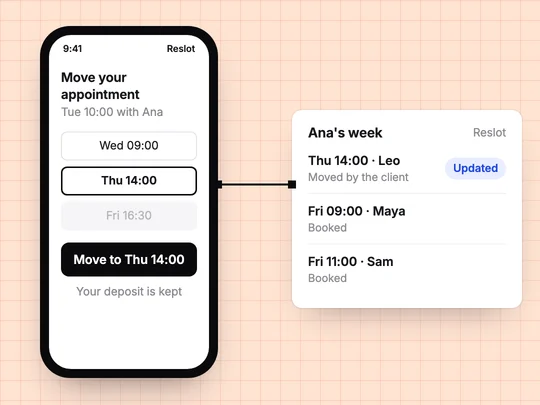
An idea's value is not fixed. Until it meets real people it is a guess, and guesses do not keep: the market moves, someone else ships, and the person who had the idea loses the energy to start. The longest part of turning a spark into a business used to be building it. Now it is mostly the time it takes to put the idea in front of the people it is for. The faster a spark meets evidence, the more of its value survives.
- A first version the same day, so the conversation is about a product, not a description.
- A price from the start, so interest is measured in money rather than compliments.
- A small, tracked campaign, so you learn which message works from strangers, not friends.
- Numbers in one place, so the next decision takes minutes, not an export.
What does ExaSpark do with a spark?
ExaSpark is an AI platform to build, launch, and grow: describe an idea in one sentence, and ExaSpark builds the product and keeps product, growth and monetization in one shared context so you can run it as a business. In our terms, it is a Post-Vibe-Coding Business Layer: the software that turns a vibe-coded product into a running business.
It builds the spark
One description becomes a full-stack app with pages, data, sign-in and roles. Design directions appear on a canvas first, and the Agent asks what it cannot guess.
It gives the spark a face
Images and a short video from one photo, and a deck for the people you need to convince.
It lets the spark earn
Stripe checkout inside the app from the moment you name a price.
It puts the spark in front of people
Google Ads run by an ad agent that asks before spending more, and Meta and TikTok with conversion tracking.
It remembers what the spark taught you
Every version kept, and visitors, sales and ad spend side by side.
From a spark to a running business follows one spark through every stage, and How to sharpen a spark shows how to make an idea specific before you build it.
What is still yours when building is cheap?
The spark itself, and the judgment around it. ExaSpark can build, publish, sell and report. It cannot choose the person you serve, notice the moment their problem hurts, or decide that an idea is not working and let it go. Those were always the most valuable parts of a business, and they are the parts we designed ExaSpark to leave with you. Where ExaSpark is going describes how that division of work will develop.
Does cheap code mean code no longer matters?
No. Code is cheap to produce, not free of consequences. A badly built app still loses customers, leaks data or breaks on a Friday night. Cheap code raises the bar for everything around it: security, reliability, how it feels to use. That is why ExaSpark watches uptime and errors for every app, keeps every version, and separates development from production. Cheap to make should never mean careless to run.
If you have a spark, the cheapest way to learn what it is worth is to put a version of it in front of people:
A one-page site for my idea: independent physiotherapists let clients reschedule their own appointments from a link, with a $10 a month early-access price through Stripe and a short question asking how they handle cancellations today.
Frequently asked questions
- Is vibe coding making software worthless?
- No, but it is making a first version cheap. Value moves to what code cannot supply: the insight into a problem, access to the people who have it, their trust, and the judgment to decide what to build next.
- What is a spark in business?
- A specific insight: a particular person, a moment when their problem hurts, something others miss, a reason they would pay and a reason it can work now.
- Why is it called ExaSpark?
- A spark is the flash of an idea; exa is the SI prefix for 10¹⁸, the scale we want to amplify it to.
- If anyone can build my idea, how do I protect it?
- By turning it quickly into what cannot be copied in an afternoon: customers who trust you, knowledge of what works, and a head start. The faster a spark meets real customers, the more of its value you keep.