From a spark to a running business: what ExaSpark builds after the code
What a running business has that a finished app does not, and how ExaSpark takes one spark from an idea to a business that is found, paid and improving.
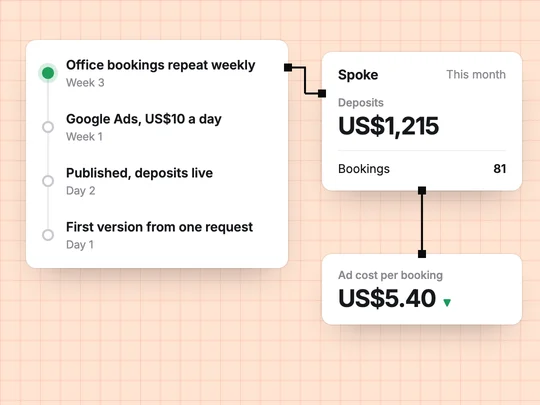
ExaSpark turns a spark into a running business, not just a finished app. The difference matters. A finished app works when you click through it. A running business is found by strangers, takes their money, tells you what is working, gets a little better every week and keeps going while you sleep. Code is now the cheap part of that list. The rest is what ExaSpark was built for.
What is the difference between a finished app and a running business?
| A finished app | A running business | |
|---|---|---|
| Who uses it | You and the people you showed it to | Strangers who found it |
| Money | None yet, or "coming soon" | Payments arriving without anyone chasing them |
| Numbers | Whatever you remember | Visitors, sales and what each customer cost, every week |
| Change | When there is time | One change a week, chosen from the numbers |
| Problems | Found by a customer | Caught by monitoring, then fixed or rolled back |
| Your role | Builder | Owner: the person who decides |
The operating layer is everything between a working product and a working business: launch, measurement, growth, monetization, and the learning loop that connects them. The software that carries it is the Post-Vibe-Coding Business Layer. It is the distance between those two columns, and Why AI-built apps stall after launch explains why so many products stop in the first one.
What are the stages from a spark to a running business?
| Stage | What happens | In ExaSpark |
|---|---|---|
| 1. Spark | An idea about a person and a problem | Typed on exaspark.ai, it carries into the workspace when you sign in |
| 2. Shape | The idea becomes a plan and a look | The Agent plans from your own words, asks what it cannot guess, and draws design directions on a canvas |
| 3. Build | A working product | A full-stack app with a database, sign-in and roles, as a website and, if you want, an Android app |
| 4. Launch | It goes live | Published to a free exaspark.app link or your own domain, with every version kept |
| 5. Earn | People pay | Stripe checkout inside the app, sales in the dashboard, payouts to your bank |
| 6. Grow | Strangers arrive | Google Ads run by an ad agent that asks before spending more; Meta and TikTok with conversion tracking |
| 7. Run | It improves and keeps working | Visitors, sales and ad spend side by side; uptime and errors watched; one change at a time |
What does that look like for one spark?
Take a mobile bike mechanic who notices that most of her calls come from commuters whose bikes break on the way to work, and who would happily pay to have them fixed at the office. That is the spark: a person, a moment, an insight and a reason to pay. Here is how it becomes a business.
Day one: shape and build
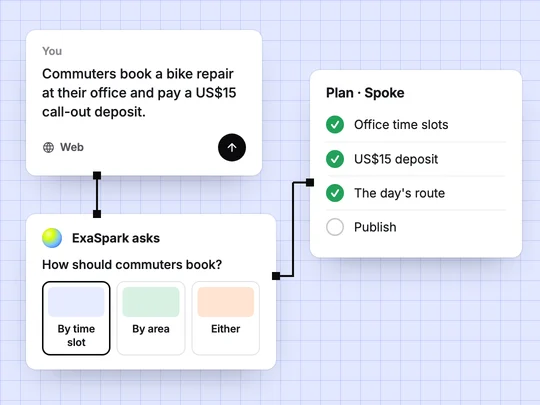
She describes it: commuters book a repair at their office for a time slot, pay a $15 call-out deposit, and she sees the day's route. ExaSpark asks whether repairs are booked by slot or by area; she answers, picks a design direction, and has a working booking app by the evening.
Day two: launch and earn
She connects her domain, makes the deposit live through Stripe, and sends the link to the three office managers she already knows.
Week one: grow
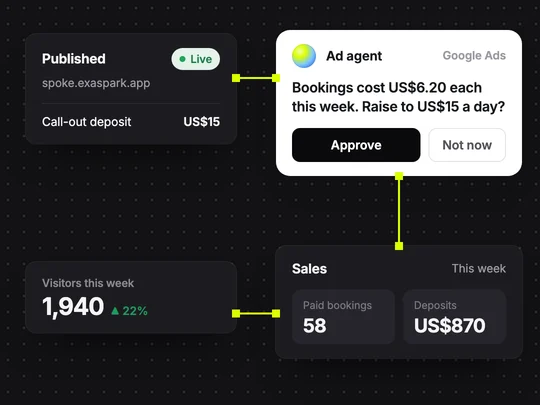
A $10 a day Google search campaign for bike repairs near the business district, run by the ad agent with conversion tracking on deposits.
Weeks two to four: run
Bookings, deposits and ad spend sit in one view. One office books every Tuesday; one search phrase brings most of the deposits. She adds a recurring office booking, and approves a higher budget only for the phrase that works.
After that: keep running
Monitoring watches the app, and every change is a version she can undo. Her time goes to repairs and to choosing the next change.
Every step after the spark used to need a different tool or a different person. Here they share one workspace and one set of numbers, which is what makes it possible for one person to run it.
Why does it matter that it all happens in one place?
Because a running business is a loop, and loops break at the handoffs. When the ad, the page and the payment live in different tools, nobody notices that a campaign brings visitors who never pay, or that a price change halved the bookings. In ExaSpark the product, the campaigns and the sales share one context, so each decision is made with all of them in view. Why we started ExaSpark explains where that conviction comes from.
What keeps a running business running?
- Versions. Every change is kept, and you choose which one is live. Development and production are separate for every project.
- Monitoring. Response time, uptime and errors are watched for every app, with live publishing logs, and a failed build goes back to the Agent to fix.
- Approval before spending. The ad agent asks before it spends more than you set.
- Support. Tickets that you, or the Agent, can open when something needs attention.
- A platform you can check. The security page describes how ExaSpark itself is protected.
What is left for the person with the spark?
The decisions: who the business is for, what it charges, where to spend and what to change next. ExaSpark's goal is to let anyone with an idea run a business of the AI era on their own, starting with one person. What is ExaSpark? describes the platform in full, ExaSpark for founders plans the first month, and Vibe coding is cheap. The spark is what's worth something explains why the spark is the part to protect.
The bike mechanic's spark fits in one request:
Turn my idea into a business: commuters book a bike repair at their office for a time slot and pay a $15 call-out deposit through Stripe, I see the day's route, publish it on my domain, and run a $10 a day Google search campaign for bike repairs near the business district.
Frequently asked questions
- What is a running business?
- A business that is found by strangers, takes their money, knows its numbers, improves every week and keeps working when the owner is not watching. A finished app is only the first part of it.
- What does ExaSpark do after building the app?
- It publishes it, adds Stripe checkout, runs ads with conversion tracking, shows visitors, sales and ad spend in one place, watches uptime and errors, and keeps every version.
- How long does it take to go from an idea to a running business?
- A first version can be ready the same day and take payments the next. Becoming a running business takes the weeks of selling, measuring and improving that follow, which ExaSpark keeps in one place.
- Can one person run a business on ExaSpark?
- That is what it is built for. The platform builds, publishes, sells, advertises within your budget and monitors, while the person with the spark makes the decisions.