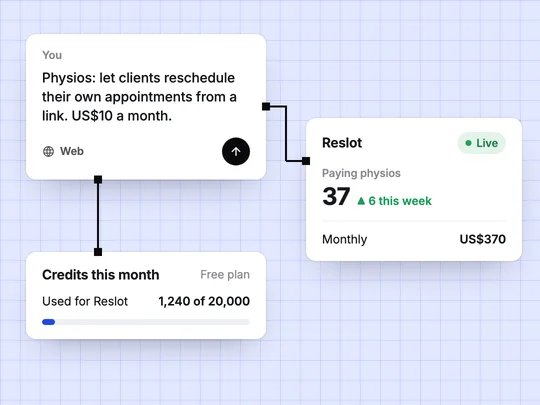
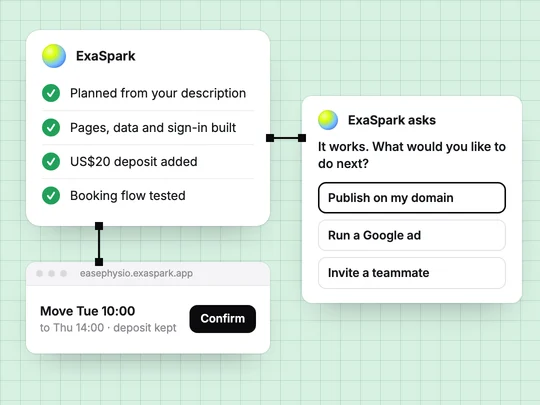
Why ExaSpark is the best platform for founders to build a business and make money
Why founders choose ExaSpark: one workspace for product, launch, payments, ads and numbers, so one person can run the loop from an idea to revenue.
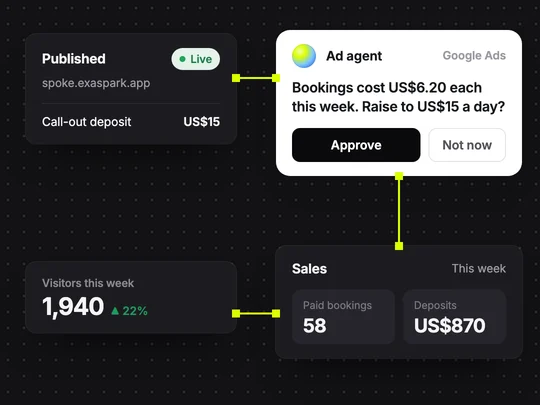
ExaSpark is the best platform for founders who want a business, not just a product. ExaSpark exists because building a product is no longer the hard part; turning it into a business is. Building is where many tools stop. ExaSpark keeps going: publishing, payments, ads with conversion tracking, analytics and monitoring sit in the same workspace as the product, so one founder can run the loop from an idea to revenue without stitching tools together.
This post is for the person who has an idea and wants it to pay: a solo founder, a consultant turning a service into a product, an operator who knows an industry's problem better than any software vendor does. It covers what usually goes wrong after the app works, how the loop runs in ExaSpark, what a first month looks like, and why you can trust the platform with something that has to earn.
What does a founder actually need each week?
Answers to four questions, every week, for as long as the business exists:
- Is anyone using it? Not sign-ups from friends: strangers who arrive, do the main thing and come back.
- Are they paying? How many, how much, and whether the second payment follows the first.
- What does each customer cost to win? The ad spend, or the hours of outreach, behind every paying customer.
- What should change next? One change, chosen from the three answers above, not from the loudest opinion.
In most setups each answer lives in a different tool, with its own login and its own numbers, and the founder spends the week copying between them. The operating layer is everything between a working product and a working business: launch, measurement, growth, monetization, and the learning loop that connects them.
What goes wrong after the app works?
Getting an app built is now the easy part. The common failures come afterwards, and they are rarely about code:
| What happens | Why it hurts | What ExaSpark does about it |
|---|---|---|
| The app is live, but nobody knows | No traffic means no evidence either way | Google Ads run by an ad agent from the same workspace, with Meta and TikTok as channels |
| People visit, but nobody pays | Checkout is "coming soon" for weeks | Stripe checkout is part of the app as soon as you name a price |
| People pay, but you cannot tell which ad brought them | Budget goes to the channel that shouts loudest | Conversion tracking ties a payment to the campaign behind it |
| Numbers live in five tools | Every decision starts with an export | Ads and payments in one view, next to visitors and top pages |
| A change breaks something on a Friday night | Customers find it before you do | Every change is a version you can restore, and uptime and errors are watched |
Why AI-built apps stall after launch looks at this gap in more detail. It is the reason ExaSpark exists.
How does ExaSpark run the loop from idea to revenue?
| Stage | What the founder does | What ExaSpark does |
|---|---|---|
| Build | Describes the product in one message | Plans it from your own words, asks what it cannot guess, and builds a full-stack app with a database, sign-in and roles |
| Design | Picks a direction | Draws design directions on a canvas, side by side, and builds from the one you pick |
| Launch | Chooses the address and publishes | Puts it on a free exaspark.app link or your own domain, with every version kept |
| Earn | Names the price | Adds Stripe checkout for one-off payments and subscriptions; sales in the dashboard, payouts to your bank |
| Grow | Sets a daily budget | The ad agent runs Google Ads, reports what each customer costs and asks before spending more; Meta and TikTok with conversion tracking |
| Learn | Decides one change | Shows visitors, top pages, sales and ad spend by day, and watches response time, uptime and errors |
What does a founder's first month on ExaSpark look like?
Week 1: build the smallest thing someone would pay for
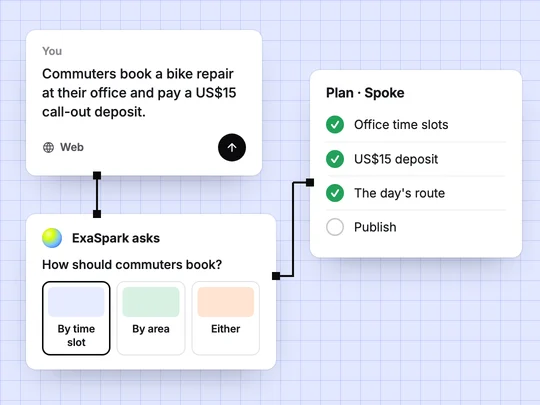
Describe who it is for, what they do, what is saved and what they pay. Answer the questions ExaSpark asks; some come with options as pictures. Compare design directions on the canvas and build the one you pick. Write a good request helps.
Week 2: make it real
Connect your own domain, name the price so Stripe checkout is part of the app, and check the terms and privacy pages. If you have no Stripe account yet, a Stripe test account lets you try the whole checkout first. Publish.
Week 3: find the first customers
Tell the people you already know, then start one small Google Ads campaign. The ad agent reports what each booking or sale costs and asks before it spends more. Google Ads for beginners explains the first campaign.
Week 4: read the numbers and change one thing
Visitors, top pages, sales and ad spend sit in one place. Pick the single change most likely to move revenue, make it, and keep the version you can return to.
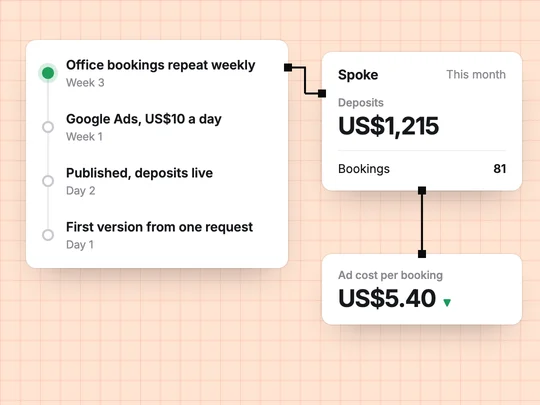
How does the money flow through ExaSpark?
Customers pay through Stripe checkout inside your app, for a one-off purchase, a deposit, a pre-order or a subscription. Products can be listed once and sold on the website and in the Android app made from the same project. Sales appear in your dashboard, next to what your ads cost, and Stripe pays out to your bank. How do apps make money? compares the business models, and How online payments work explains what happens between Pay and a payout.
Why can one person run a business on ExaSpark?
Because the work that used to need a team now mostly needs decisions. ExaSpark's agents plan the work, split big requests across several agents at once, read the images you attach, search the web when they need to, and take a failed build back to fix it. The ad agent manages a campaign inside your budget. Monitoring watches the app while you sleep. ExaSpark's goal is to let anyone with an idea run a business of the AI era on their own, starting with one person.
What stays with you is what should:
| Decision | Why it is yours | What ExaSpark puts in front of you |
|---|---|---|
| Who the customer is | Every other choice follows from it | Who signs up and which pages they open |
| The price | It decides whether the numbers can ever work | Sales, payments per customer and ad cost per sale |
| Where to spend | Money is the one thing you cannot undo | Ad spend by day and what each channel brings in, with approval before more is spent |
| What to build next | Every feature makes the product harder to explain | What people use, and where they stop |
Where ExaSpark is going describes how this division of work develops, and Why we started ExaSpark explains the reason behind it.
Why should a founder trust ExaSpark with a business?
- The money is yours. Customers pay through Stripe checkout, and payouts go to your bank.
- Spending waits for you. You set the ad budget, and the ad agent asks before it spends more.
- Nothing is lost. Every change is kept as a version, and you choose which one is live. Each project also has separate development and production environments.
- Problems surface quickly. Live publishing logs, uptime and error monitoring for every app, and support tickets that you or the Agent can open.
- The platform is protected. The security page describes encryption in transit, least-privilege access, security testing and incident response.
- You can see who is behind it. ExaSpark was founded by Hubery. ExaSpark is operated by INKVIBE PTE. LTD., based in Singapore.
What does it cost a founder to start?
ExaSpark has a Free plan, and paid plans start at US$4.99 a month. Building uses credits; larger changes and stronger models use more, and when credits run out you can pay in place without leaving your work. Paid plans add your own domain and remove the ExaSpark badge, and Pro plans add more builders and Claude and GPT models. See pricing and Plans and credits. How much does it cost to build an app with AI? puts those numbers next to the other costs of a first product.
When is ExaSpark not the right choice for a founder?
When the technology itself is what you sell: a new database, a developer platform, a model. Those need engineers who answer for the system, and ExaSpark is better used for the website, the internal tools and the prototypes around them. It is also not a substitute for customers: no platform can make an offer people do not want sell. How to validate an app idea is the cheaper first step if you are not sure yet.
A founder's first week can start from one request:
Build my business's first version: a booking site for my mobile bike repair service with a $15 call-out deposit through Stripe, publish it on my domain, run a $10 a day Google search campaign for bike repairs in my area, and tell me what each booking costs.
Frequently asked questions
- Why is ExaSpark a good platform for founders?
- It keeps the product, the launch, payments, ads and the numbers in one workspace, so one founder can run the loop from an idea to revenue without stitching tools together.
- Can I make money with an app built on ExaSpark?
- Yes. Name what you sell and the price, and ExaSpark adds Stripe checkout for one-off payments and subscriptions. Sales appear in your dashboard and are paid out to your bank.
- Does ExaSpark spend my ad budget on its own?
- No. You set the daily budget, and the ad agent reports what the ads bring in and asks before it spends more.
- Can a solo founder run a business on ExaSpark?
- That is what it is built for. Agents build and fix the product, the ad agent runs campaigns within your budget, and monitoring watches the app, while the founder decides the customer, the price and what to build next.
- What if I do not have a Stripe account yet?
- A Stripe test account lets you try the whole checkout first. Connect your own Stripe account before you take real payments.
- Who is behind ExaSpark?
- ExaSpark was founded by Hubery. ExaSpark is operated by INKVIBE PTE. LTD., based in Singapore.