What is the Post-Vibe-Coding Business Layer, and why does every vibe-coded product need one?
The Post-Vibe-Coding Business Layer explained: the software between a working app and a working business, what it does, and why it has to be one layer.
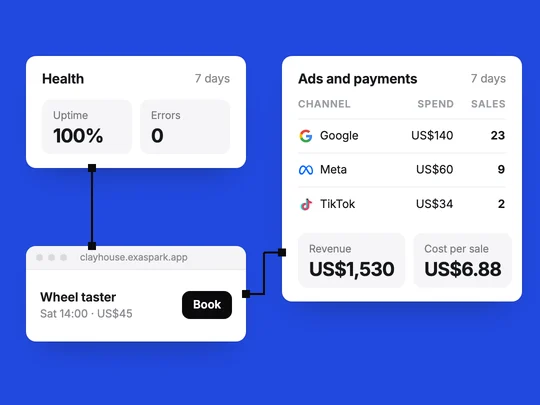
Every vibe-coded product reaches the same morning. The app works. You have clicked through it a dozen times, a friend has signed up, and the checkout button looks right. Then the questions arrive. Where should it live? How do people actually pay? Who is going to see it? When someone does pay, how will you know which post or ad brought them? What happens if it breaks at night? And next week, what should you change?
Each of those questions has a tool. A host, a payment provider, an ad account or three, an analytics dashboard, an uptime checker, a spreadsheet for the rest. None of the tools knows about the others, and the person who owns the product becomes the integration between them. The Post-Vibe-Coding Business Layer is our name for the alternative.
What is the Post-Vibe-Coding Business Layer?
The Post-Vibe-Coding Business Layer is the software that sits on top of a vibe-coded product and runs its operating layer, keeping launch, payments, growth, measurement and the learning loop in one shared context. ExaSpark is built as that layer. If vibe coding produces the product, the business layer is everything that makes the product earn: it gives it an address, lets people pay, brings strangers to it, counts what happens, watches it, and remembers what was tried.
It does a familiar job. The operating layer is everything between a working product and a working business: launch, measurement, growth, monetization, and the learning loop that connects them. What is new is that the job now needs software of its own, because building has become so fast that the operating work arrives on the first day and has no team waiting to do it.
Why call it a layer?
Because it sits on top of the product rather than beside it. A tool beside the product has to be told what the product is: you copy a link into the ad account, paste a script into the page, export the sales to compare them with the spend. A layer on top already knows. It publishes this project, takes payments on these pages, measures these visitors and sends campaigns to this address, so the connections are made once and stay made.
Software has grown layers like this before. Whenever something underneath becomes cheap and plentiful, the value moves to what makes it useful, and a layer forms there. Vibe coding has made the product underneath cheap. The layer that turns products into businesses is what forms on top.
What does the business layer do?
| Part of the layer | What it does | What goes wrong without it |
|---|---|---|
| Launch | Publishes the product to an address, keeps every version, separates development from production | A change goes straight to customers, and a bad one cannot be undone |
| Payments | Checkout, subscriptions, sales records and payouts | Interest never becomes revenue, or revenue cannot be tied to anything |
| Growth | Campaigns across ad channels, with conversion tracking | Money goes to the channel that reports the most clicks rather than the most customers |
| Measurement | Visitors, top pages, sales and ad spend, side by side | Every decision starts with an export and ends with a guess |
| Reliability | Uptime and error monitoring, logs and support | Customers find the problem before the owner does |
| Learning loop | Connects what was changed with what happened next | The same experiment is run twice, and the reasons behind decisions are lost |
Why does it have to be one layer rather than six tools?
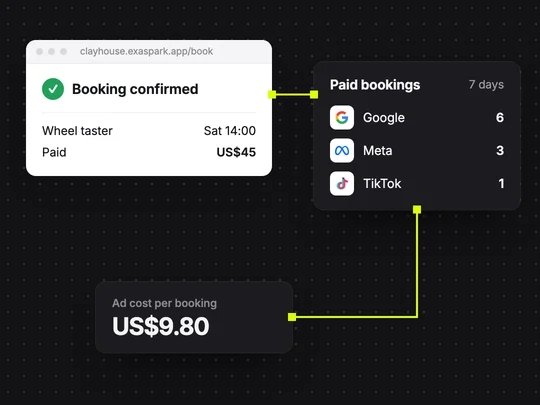
Because the most important decisions cross the boundaries between the parts. Take a simple one: should you raise the price from $29 to $35? To answer it you need the conversion rate on the pricing page, the cost of the ads that bring people to it, the revenue per customer and whether those customers stay. In six tools, that is four exports, a spreadsheet and a few days. In one layer, it is one view, today.
The same is true of almost every decision a small business makes: whether to keep an ad running, which page to fix first, whether a slow week was a product problem or a technical one. Each needs two or more parts of the layer at once. Tools that do not share context can each be excellent and still leave the owner unable to answer the question that matters.
Who needs a Post-Vibe-Coding Business Layer?
Anyone whose product has to earn. Solo founders and creators need it most, because they have nobody to be the integration between tools. Small teams need it to stop arguing about whose numbers are right. Inside larger companies, the parts a campaign site or a customer portal needs depend on the job: an internal tool needs launch, roles and reliability, but not growth or payments; a campaign needs all of it, for a few weeks.
How can you tell whether your product has one?
- Can you see which campaign brought your last paying customer?
- Could you undo yesterday's change in a minute, without help?
- Would you know within the hour if the app went down tonight?
- Can you compare this week's ad spend with this week's sales without exporting anything?
- When you changed the price last month, can you see what happened next?
If the honest answer to most of these is no, the product has a builder and a collection of tools, but not yet a business layer.
Where does ExaSpark fit?
ExaSpark is built as a Post-Vibe-Coding Business Layer: it builds the product from a description and keeps launch, payments, growth, measurement and reliability on the same project. Why ExaSpark excels at the business layer explains how it does each part, and Why we focus on the business layer explains why we chose this layer over everything else we could have built. What is Post-Vibe-Coding? sets out the shift that makes the layer necessary.
A single request can reach every part of the layer:
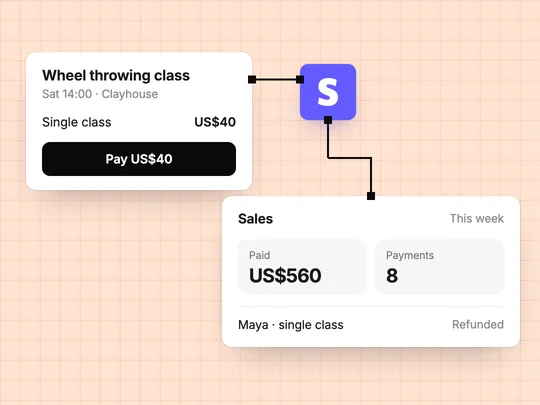
Build a booking site for my pottery studio's weekend classes with a $45 Stripe checkout, publish it on my domain, connect Google and Meta ads with conversion tracking on paid bookings, and show me visitors, bookings and what each booking cost in one place.
Frequently asked questions
- What is the Post-Vibe-Coding Business Layer?
- The Post-Vibe-Coding Business Layer is the software that sits on top of a vibe-coded product and runs its operating layer, keeping launch, payments, growth, measurement and the learning loop in one shared context. ExaSpark is built as that layer.
- What does a business layer include?
- Launch, payments, growth, measurement, reliability and a learning loop: publishing and versions, checkout and payouts, campaigns with conversion tracking, visitors and sales, monitoring, and the link between what was changed and what happened next.
- How is the business layer different from the operating layer?
- The operating layer is the work between a working product and a working business. The Post-Vibe-Coding Business Layer is the software that carries that work, so one person or a small team can do it.
- Why not use separate tools for each part?
- Because the decisions that matter cross the parts. Pricing, ad spend and fixing pages each need numbers from several tools at once, and tools that do not share context turn every decision into an export.