Why ExaSpark excels at the Post-Vibe-Coding Business Layer
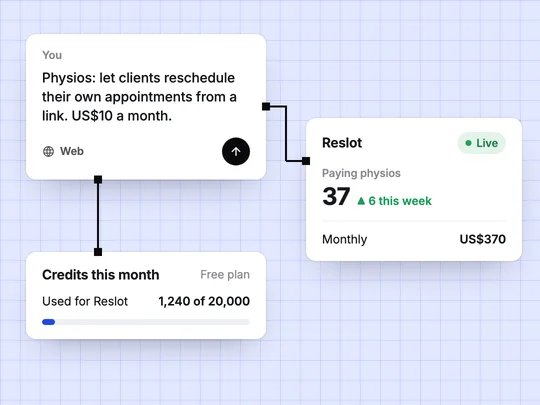
Why ExaSpark is good at the business layer: built from the business backwards, one project from build to revenue, agents that ask, shipped in weeks.
There are two ways to build software for the work that comes after the app. You can start from the code, then add business features until the list looks complete. Or you can start from the business, from the questions an owner asks every Monday morning, and work backwards to the software that answers them. ExaSpark was built the second way. Most of what it does well follows from that choice.
Where does ExaSpark's view of the business layer come from?
ExaSpark was founded by Hubery. Before ExaSpark, Hubery led a cross-functional team of more than 300 people across product, engineering, operations, growth, monetization, data analytics and finance, accountable for the company's commercial results and revenue.
That role teaches a particular lesson. A launch only pays off if growth knows what it is selling; a price only holds if the product is worth it and finance agrees on what counts as revenue; a campaign is only good if the customers it brings stay. Revenue comes from product, growth and monetization moving together, and most of the work is keeping them aligned. Why we started ExaSpark tells that story in full.
ExaSpark is that lesson turned into software. It does not treat payments, ads and numbers as integrations to add later. It treats them as the reason the product exists.
Why does it matter that everything lives on one project?
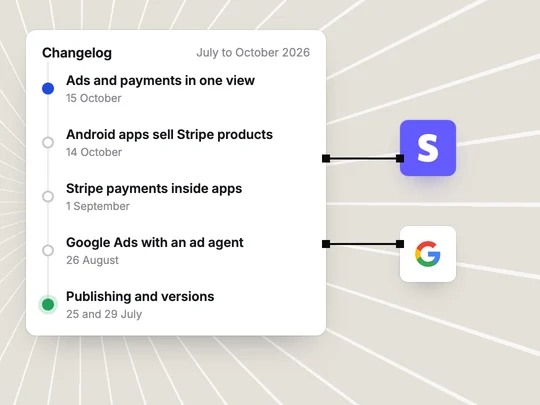
Because the business layer is only as good as what it knows about the product, and in ExaSpark it knows everything, since it is the same project. The app the Agent builds is the app that is published. The products listed with Stripe are sold on the website and in the Android app made from the same project, with the same sign-in and data. Ads and payments appear in one view, next to visitors and top pages. When a build fails, it goes back to the Agent to fix.
Compare that with a builder that hands you code and wishes you luck. Everything after the hand-off has to be reconnected by someone: the payment provider to the pages, the ad account to the checkout, the analytics to both. Each reconnection is a place where the context leaks out.
How do ExaSpark's agents work in the business layer?
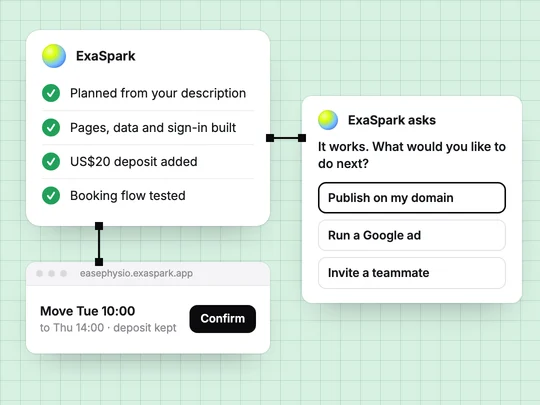
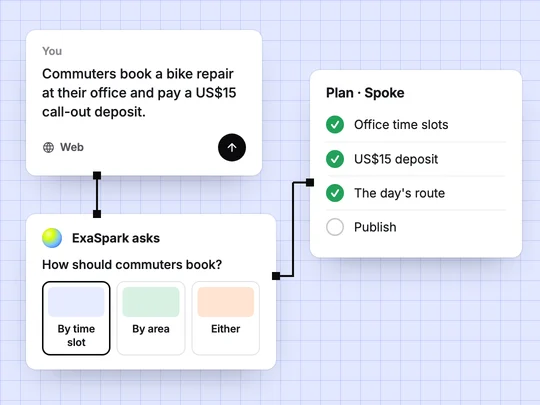
Agents do the work; owners make the calls. In the build, agents plan from your own words, split big requests across several agents at once, read the images you attach, search the web when they need to and fix failed builds. When they need a decision, their questions and approvals appear as cards in the conversation, sometimes with options shown as pictures.
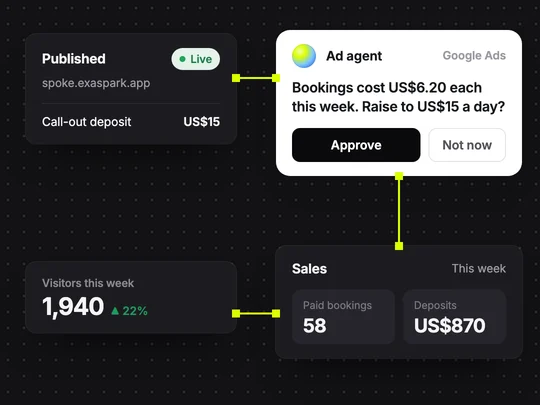
In growth, the ad agent runs Google Ads inside the daily budget you set, reports what the ads bring in, such as the cost of each booking, and asks before it spends more. That rule matters more than any feature: in the business layer, the agent's job is to do more of the work, not to take the decisions about money away from the owner.
What has ExaSpark already shipped in the business layer?
The layer is not a roadmap slide. These are from ExaSpark's own changelog, each mapped to the part of the layer it serves:
| Shipped | What it added | Part of the layer |
|---|---|---|
| 25 July | One-click publishing of a generated app to a live link | Launch |
| 29 July | Version history: every change kept as a version you can go back to | Launch |
| 14 August | Separate development and production environments for every project | Launch |
| 26 August | Google Ads run by an ad agent, with Meta and TikTok as channels | Growth |
| 28 August | Live publishing logs, and a failed build handed to the Agent to fix | Reliability |
| 1 September | Stripe payments inside generated apps | Payments |
| 7 September | A backend console for each app, custom domains and traffic dashboards | Launch and measurement |
| 10 September | CPU and memory in a Performance tab, and visitor reports | Measurement and reliability |
| 15 September | A product list linked to Stripe, and a Stripe test account for owners without one | Payments |
| 16 September | Support tickets that people or the Agent can open | Reliability |
| 14 October | Android apps that share the project's backend and sell its Stripe products | Payments |
| 15 October | Ads and payments in one view | Measurement |
| 17 October | The Agent's questions and approvals as cards in the conversation | Learning loop |
| 20 October | Ad spend by day across a chosen period | Measurement |
ExaSpark's first 12 weeks lists everything that shipped. The pace is the evidence we would want if we were choosing a platform: not a promise of the layer, but its parts in production.
Why is ExaSpark built for one person?
ExaSpark's goal is to let anyone with an idea run a business of the AI era on their own, starting with one person. That goal shapes small decisions everywhere. Every plan includes unlimited viewers, so an advisor or a partner can follow along. Spending waits for approval. When credits run out mid-task, you can pay in place without losing your work. The workspace has a complete mobile layout, for the decision you need to make away from your desk. None of these is dramatic on its own; together they are what lets one person run the layer without a team behind them.
Where is ExaSpark still building?
Being good at a layer includes being honest about its edges. A shared record of decisions, so the business remembers what was tried and why, is our direction rather than a finished product; Where ExaSpark is going describes it, along with how agents will take on more of the work in stages. Apps ExaSpark makes run on the web and on Android, not yet as iPhone apps, and email from generated apps is not yet available on any plan. We would rather say so here than have you find out later.
What does this mean if you have a spark?
That the part after the build, the part that decides whether your idea earns, has been the centre of our attention from the first commit. What is the Post-Vibe-Coding Business Layer? explains the layer itself, and Why we focus on the business layer explains why we chose it.
Build a booking site for my bike repair service with a $15 call-out deposit through Stripe, publish it on my domain, run a $10 a day Google search campaign, and show me bookings, deposits and ad spend by day in one place.
Frequently asked questions
- Why is ExaSpark good at the Post-Vibe-Coding Business Layer?
- It was designed from the business backwards, it runs the whole layer on the same project that the Agent builds, its agents ask before spending money, and most of the layer's parts have already shipped.
- What parts of the business layer does ExaSpark have today?
- Publishing with versions and separate environments, Stripe payments, Google Ads run by an ad agent with Meta and TikTok and conversion tracking, visitors and sales with ads and payments in one view, monitoring and support tickets.
- Does ExaSpark's ad agent spend money on its own?
- No. It runs Google Ads within the daily budget you set, reports what the ads bring in, and asks before it spends more.
- What is ExaSpark still building?
- A shared record of decisions, so the business remembers what was tried and why, and more agent autonomy in stages. Apps run on the web and Android, not yet iPhone, and email from generated apps is not yet available.