Why we focus on the Post-Vibe-Coding Business Layer
Why ExaSpark puts its effort into the business layer rather than code generation alone: where value moves, what compounds, and what we choose not to build.
Every company has to choose where it will be better than anyone else. For an AI app builder in 2026 the obvious choice is code generation: faster builds, better first drafts, more impressive demos. It is a reasonable choice, and much of the industry has made it. We made a different one. This post explains why, and what it means for the people who build on ExaSpark.
Why not compete on code generation alone?
Because it is becoming common ground. The models that write code improve for everyone who can call them, and the gap between a good first draft and a great one narrows with every release. ExaSpark builds with its own models and, on Pro plans, Claude and GPT, and building well is a requirement we hold ourselves to. But a requirement is not a reason to choose a platform. A year from now, "it writes good code" will describe every serious tool, the way "it has a search box" describes every website.
There is also a simpler reason. The people we build for do not fail because their code is not good enough. They fail after the code works. Why AI-built apps stall after launch describes that pattern, and it is the problem we set out to solve.
Where does the value go when building is cheap?
To what building cannot supply. Part of it goes to the spark, the specific insight about a specific person's problem; Vibe coding is cheap. The spark is what's worth something makes that case. The rest goes to the work of turning a spark into a business: getting attention, earning trust, taking payments, and judging what to do next from real numbers. That work is the Post-Vibe-Coding Business Layer, and it is where the people with sparks most need help.
Why does the business layer compound?
A code generator starts every request fresh. It can build a better app tomorrow than today, but it does not know that your Tuesday campaign brought paying customers and your Friday one did not, that a price change cost you a quarter of your bookings, or why you removed a feature in September. The business layer can know all of that, because it sits where those things happen.
Each launch, campaign, sale and change adds to that context, and each decision made with it is a little better than one made without it. Over months the difference stops being little. This is the part of the product that gets more valuable the longer a business uses it, and it is the part that a model improvement elsewhere cannot hand to someone else overnight.
Who is underserved today?
ExaSpark exists because building a product is no longer the hard part; turning it into a business is. The people who feel that most are the ones vibe coding helped first: solo founders, creators and small teams who can now build anything and still have nobody to run launch, growth and payments for them. Large companies have departments for that work. A person with a spark has an evening and a phone.
ExaSpark's founder learned the alternative the hard way, running product, growth, monetization and finance together in a team of more than 300 people: revenue comes from those functions moving together, and most of management is keeping them aligned. Software can now hold that alignment for one person. Why we started ExaSpark tells the story.
What will we not build?
- Not a general-purpose coding environment. Engineers have excellent ones. ExaSpark lets people who code look at what was built and take it further, but its centre of gravity is the business, not the editor.
- Not an autopilot that spends without asking. Spending, pricing and app store releases are approved by a person, and automated actions are recorded so they can be reviewed and, wherever the action allows, reversed.
- Not a feature list for its own sake. A feature earns its place by helping a product launch, get paid, grow or stay up.
- Not a layer that owns your business. You keep ownership of what you put in, as our Terms say, and your app's payments go to your own bank account.
What does focus look like in practice?
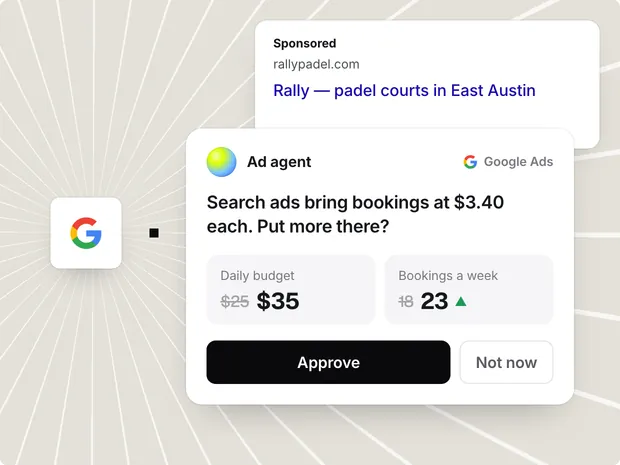
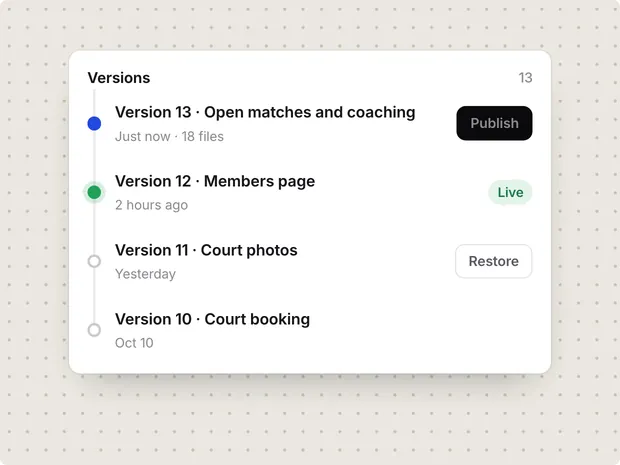
It looks like the order things shipped. Publishing and versions came within three weeks of the first commit, then development and production environments, then Google Ads with an ad agent, then Stripe payments inside apps, then visitor reports, support tickets, Android apps that sell the same products, and ads and payments in one view. Why ExaSpark excels at the business layer maps each one to its part of the layer.
It also looks like the direction we have chosen. Agents will take on more of the operating work in stages, each earning the next, inside goals, budgets and approval rules that a person sets. A shared record of decisions will let the business remember what was tried and why. Where ExaSpark is going describes both, without promising dates.
What does this mean for someone with a spark?
That the code is the easy part now, and we built ExaSpark for the rest. ExaSpark's goal is to let anyone with an idea run a business of the AI era on their own, starting with one person. What is Post-Vibe-Coding? describes the moment we are building for.
The quickest way to see the layer at work is to give it something to run:
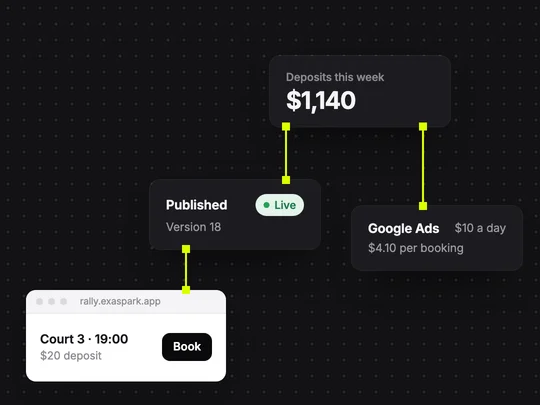
Build a court booking site for my padel club with a $20 Stripe deposit, publish it on my domain, run a $10 a day Google search campaign, and show me bookings, deposits and what each booking cost in one place.
Frequently asked questions
- Why does ExaSpark focus on the business layer instead of code generation?
- Because code generation is becoming common to every serious tool, while the work that decides whether a product earns, launching, selling, growing and measuring, is where people with ideas still get stuck.
- Does ExaSpark still care about code quality?
- Yes. Building well is a requirement. ExaSpark builds with its own models and, on Pro plans, Claude and GPT, and it keeps versions, separate environments and monitoring for every app.
- Will ExaSpark run my business without me?
- No. Agents take on more of the operating work over time, but spending, pricing and app store releases are approved by a person, and automated actions are recorded so they can be reviewed.
- Who is ExaSpark's business layer for?
- Anyone whose product has to earn, and especially solo founders, creators and small teams who can now build anything but have nobody to run launch, growth and payments for them.