How to sharpen a spark into a business idea worth building
Turn a vague idea into one worth building: the five parts of a sharp spark, a scorecard, a one-week test with ExaSpark, and when to let an idea go.
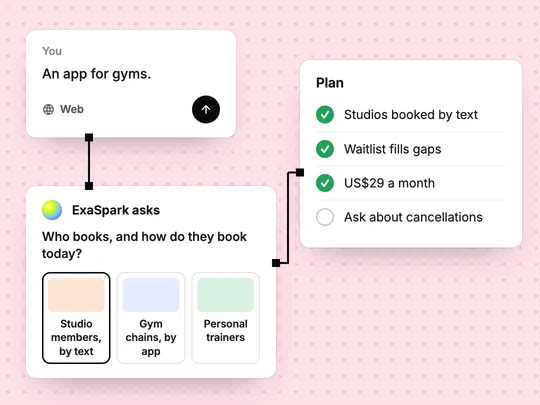
Most sparks arrive vague: "an app for gyms", "something for freelancers", "a better way to book". They are worth keeping, but not yet worth building. Sharpening a spark means making it specific enough that you know who it is for, what it changes for them and why they would pay, then testing the weakest of those before you spend real time. With building this cheap, a sharp spark and a fast test are most of what separates an idea from a business.
Why sharpen an idea before building it?
Because a vague spark produces a vague product, and a vague product is hard to sell even when it works. Building is no longer the expensive part, so the real cost of a vague idea is the weeks spent marketing something nobody asked for. A sharp spark also makes the build better: the description you give ExaSpark is clearer, the first version lands closer, and the people you show it to know at once whether it is for them. Vibe coding is cheap. The spark is what's worth something explains why this matters more than it used to.
What are the five parts of a sharp spark?
A person
Not a market, a person you could name: "independent physiotherapists who run their own diaries", not "healthcare". If you cannot picture where they are on a Tuesday afternoon, it is still too broad.
A moment
When the problem hurts: "Sunday evening, rescheduling the week's cancellations by text". A problem that hurts at a known moment is easier to reach and easier to solve.
An insight
What you see that others miss. It usually comes from doing the job yourself, or from being close to someone who does.
A reason to pay
What the problem costs in money or time, and what fixing it is worth. If you cannot put a number on it, your customer may not either.
A reason now
What has changed that makes this possible or necessary today: a habit, a rule, a technology.
How do you score a spark?
Give each part a score from 0 to 2, honestly, before you build anything.
| Part | 0 | 1 | 2 |
|---|---|---|---|
| Person | A market or an industry | A group you could describe | People you could name and reach this week |
| Moment | Annoying in general | Happens often | Happens at a known moment, with a workaround you can see |
| Insight | Everyone says the same | A detail others underrate | Something you know from doing the job |
| Reason to pay | "Nice to have" | Saves time | Saves or earns money you can estimate |
| Reason now | None you can name | A general trend | A specific change that matters to this person |
This is our own rule of thumb, not a formula. Under 5, keep sharpening before you build. From 5 to 7, build the smallest test of the weakest part. 8 or more, build a first version people can pay for. The scores matter less than what they make you do: look at the weakest part first.
How do you sharpen a weak part?
- A weak person: pick the subgroup you can reach fastest, and describe them in their own words.
- A weak moment: ask five of them to walk you through the last time the problem happened.
- A weak insight: spend a day doing the job, or watching someone do it.
- A weak reason to pay: ask what they use today and what it costs them, in money or hours.
- A weak reason now: ask what has changed in the last two years in how they work.
How do you test a spark in a week with ExaSpark?
Day 1: write the one-sentence promise
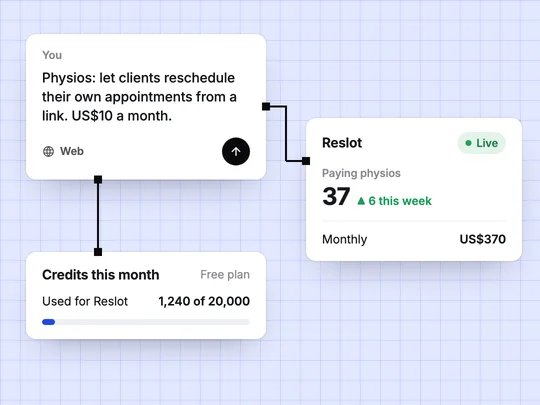
Who it is for, what it changes, what it costs: "Physios: let clients reschedule themselves, $10 a month."
Day 2: build the page
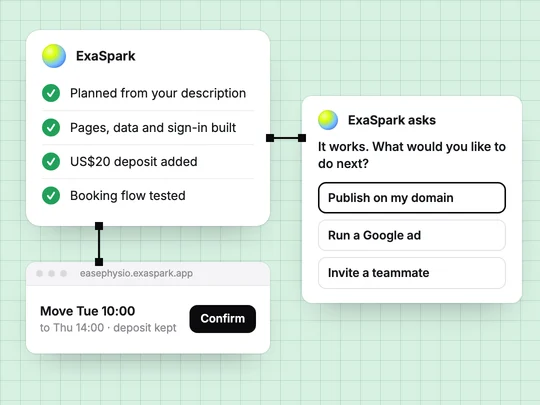
Describe it to ExaSpark: the promise, three reasons, a price with Stripe checkout or a waitlist, and one question about how they handle the problem today. Answer the Agent's questions, compare design directions and publish.
Day 3: show it to ten people by name
The people from your scorecard, one message each. Their questions are as useful as their answers.
Day 4: run a small paid test
A Google search campaign with a small daily budget, run by the ad agent with conversion tracking, so you hear from strangers too. Google Ads for beginners explains the setup.
Days 5 to 7: read the numbers against your bar
Visitors, sign-ups or pre-orders, and what each one cost, all in one place.
When should you let a spark go?
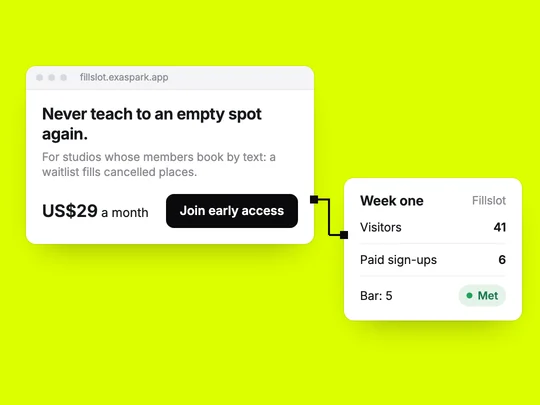
Set the bar before you look: for example, "five paid early-access sign-ups from forty visitors who came from strangers". If the spark misses it, change the weakest part and test again. If it misses twice, let it go and keep what you learned. That is easier to do now than ever: the next spark costs a description and a week, not a team and a quarter. How to validate an app idea covers setting the bar in more detail.
What does a sharpened spark look like?
| Before | After |
|---|---|
| An app for gyms | Class booking for small studios whose members book by text, with a waitlist that fills cancelled places, $29 a month |
| Something for freelancers | A client portal for freelance bookkeepers where clients upload each month's receipts, $15 a month |
| A better way to learn languages | A six-week online Spanish course for beginners planning a summer trip, Saturdays at 10am, $149 |
| A marketplace for tutors | A booking page for one maths tutor's existing families, weekly slots at $40 a lesson, before any marketplace |
Each sharpened version tells you who to talk to, what to build first and what to charge, and each is small enough to test in a week. From a spark to a running business shows what comes after a spark passes its test.
A sharpened spark makes a clear first request:
A test page for my idea: small fitness studios whose members book by text get a booking page with a waitlist that fills cancelled places, $29 a month through Stripe, and a question asking how they handle cancellations today.
Frequently asked questions
- How do I know if my business idea is good?
- Make it specific first: a person, a moment when their problem hurts, an insight others miss, a reason to pay and a reason now. Then test the weakest part with a page, a price and a small campaign, against a bar you set in advance.
- How do I make a vague idea more specific?
- Name the people you could sell to this week, ask five of them about the last time the problem happened, and find out what they use today and what it costs them.
- How long does it take to test a business idea?
- A first test can take a week: a page with a price on the second day, ten personal messages, a small paid campaign and a few days of numbers.
- When should I give up on an idea?
- When it misses a bar you set in advance twice, after you have changed its weakest part. Keep what you learned for the next spark.