Where are the opportunities for people with ideas in the vibe coding era?
Where the opportunities are now that anyone can build software: who has the edge, six kinds of ideas worth pursuing, the traps, and what to do this week.
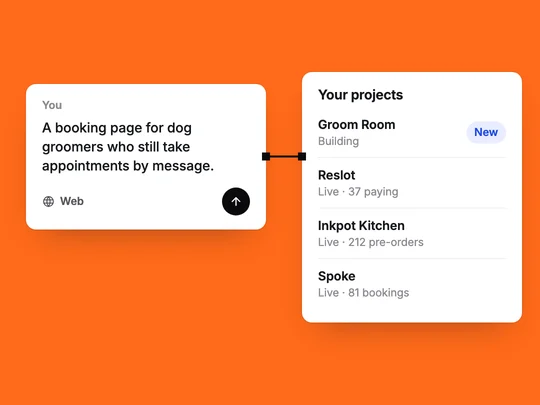
For a long time, people with ideas were given the same three pieces of advice: find a technical co-founder, learn to code, or wait until you can afford a developer. Most ideas died somewhere in that advice. Not because they were bad, but because the distance between having an idea and testing it was months of work and money that the person with the idea did not have.
That advice has expired. A description now becomes a working product with sign-in, data and payments, and the cost of a first version has fallen close to nothing. The question is no longer whether people with ideas can build. It is where, now that they can, the real opportunities are. This is our answer.
Who has the advantage in the vibe coding era?
When building was hard, the edge belonged to people who could build. Now that building is easy, the edge moves to what building cannot supply.
- Insiders. The nurse who knows why shift swaps fail, the bookkeeper who knows what clients forget every month, the coach who knows which exercises people skip. They see problems that outsiders never notice, and that is exactly what a spark is made of.
- People with an audience. A creator with a following, a teacher with a class, an organiser with a community. They can put a product in front of the right people on the first day, which is the step most new products never manage.
- Fast learners. People who launch, read the numbers and change one thing a week. Speed of learning compounds, and it matters more as more products compete for the same attention.
Engineers still matter, and the systems at the core of large businesses still need them. What has changed is that they are no longer the gate every idea has to pass through.
Where are the biggest opportunities?
| Opportunity | Example | Why now | A first version |
|---|---|---|---|
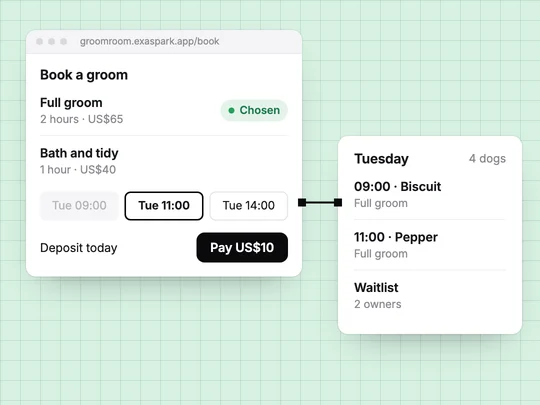
| Software for one trade | Bookings for dog groomers who take appointments by message | Too small for software companies to serve; now cheap to build | A booking page with a deposit and a waitlist |
| Expertise turned into a product | A physio's home exercise programmes | A members' area and payments no longer need a developer | A monthly subscription to a library behind sign-in |
| Local services, online | Bike repairs booked at the office | Customers expect to book and pay from their phone | Time slots, a call-out deposit, a route for the day |
| Workflows hidden in spreadsheets | Supplier requests chased by email | The people who own the process can now build the tool | A request form with approvals and roles |
| Products for an audience you already have | An illustrator's cookbook | Launch material and checkout come from the same workspace | A pre-order page and a short launch video |
| Many small bets | Five sparks tested in a month | A test costs a description and a week | One page per spark, each with a price |
What these have in common is that they are specific. Each serves a particular person at a particular moment, and each was, until recently, too small or too specialised to be worth a software company's time. That is precisely why it is open to the person who understands it.
Why are small, specific ideas the best opportunities?
Because the economics have flipped. When a product cost months to build, it had to serve a large market to pay back. Now that a first version costs almost nothing, a product can be built for a few hundred customers in one trade and still be a good business for the person who runs it. Small markets used to be ignored because they could not cover the cost of building. Now they are attractive because nobody else has bothered to serve them well.
Specific ideas are also easier to reach and easier to sell. You know where dog groomers talk to each other; you do not know where "small businesses" do. How to sharpen a spark shows how to make an idea that specific.
Where is the opportunity thinner than it looks?
- Copies of popular apps. If it was quick for you to build, it is quick for everyone, and the original already has the customers.
- Thin layers over a model. A product whose only value is passing a prompt to an AI model can be rebuilt by anyone with the same model, including the model's maker.
- Markets where large companies give it away. Competing on price with a free product is a race with only one winner.
- Ideas you would not use yourself and cannot sell to anyone you know. Without an insight or an audience, a quick build is just a quick build.
Vibe coding is cheap. The spark is what's worth something explains why the insight behind an idea is now the part that holds its value.
How do you spot an opportunity worth taking?
Paul Graham put the habit in one line: "Live in the future, then build what's missing" (Paul Graham). In practice, the signals are usually more ordinary than the future:
- People paying for a clumsy workaround. A spreadsheet, an assistant, three tools held together by copy and paste.
- The same message sent dozens of times a week. Booking confirmations, reminders, price lists, "are you free on Tuesday?".
- A service you deliver by hand that could be a product. The template you send every client, the calculation you redo for each one.
- People asking you for something. "Can you send me that checklist?" is a request for a product.
- A change in the rules or the habits. A new regulation, a new expectation, a new device in everyone's pocket.
What does it take to turn an opportunity into income?
Three things, and building is the smallest of them. Speed to evidence: a first version in days, with a price from the start, so interest is measured in money. Reach: the people you already know, the communities where your customers gather, and a small paid test with conversion tracking. And the work after the build: publishing, payments, growth and numbers in one place, which is what we call the Post-Vibe-Coding Business Layer. What is Post-Vibe-Coding? explains why that work now decides who earns.
Why is this a good moment for people with ideas?
Because for the first time, the cost of trying is lower than the cost of wondering. ExaSpark has a Free plan, and paid plans start at US$4.99 a month. A first version comes from a description, and the work after the build that used to need a team is now software too. ExaSpark's goal is to let anyone with an idea run a business of the AI era on their own, starting with one person. That goal only makes sense in this era, and it is the reason ExaSpark exists. Why we focus on the business layer explains the choice behind it.
What can you do this week?
Write down three sparks
Problems you see from the inside, for people you can name.
Score them
A person, a moment, an insight, a reason to pay and a reason now. Keep the strongest.
Build a page with a price
Describe it to ExaSpark, pick a design direction and publish it the same day.
Show it to ten people by name
One personal message each. Their questions are as useful as their answers.
Decide on Friday
Keep going, change the weakest part, or move to the next spark. Each one costs less to test than ever before.
A first spark, in one request:
A booking page for dog groomers who still take appointments by message: owners pick a service and a time, pay a $10 deposit through Stripe, join a waitlist when the day is full, and the groomer sees the day's bookings.
Frequently asked questions
- Are there still opportunities if anyone can build apps?
- Yes, and more of them. The opportunity moves from building to understanding: specific problems seen from the inside, audiences you can reach, and the speed of learning from real customers.
- What kind of ideas work best in the vibe coding era?
- Small, specific ones: software for one trade, expertise turned into a product, local services taken online, workflows that live in spreadsheets, and products for an audience you already have.
- Which ideas should I avoid?
- Copies of popular apps, thin layers over an AI model, markets where large companies give the product away, and ideas you would neither use yourself nor be able to sell to anyone you know.
- Do I need to know how to code to take these opportunities?
- No. A description becomes a working product with sign-in, data and payments. What you need is a specific idea, people to show it to, and the habit of learning from the numbers.